

You know when someone compliments your hair and asks where you go? There is now £10 in that conversation. For both of you. Here is exactly how it works, and the one rule to get right.
How it works
Three steps. The whole thing runs itself once your friend has your link.
The dos
The don’ts
Questions we hear a lot
Your Treat Card is our way of saying thank you for coming back. It lives in the NOCO Go app, it fills up on its own every time you visit, and you never lose your points. No stamps, no paper card to lose, nothing to remember.
How you earn
You earn points on everything, automatically. There is nothing to sign up for. If you have the app, you have a Treat Card.
The review and Instagram bonuses happen in the salon, while you are with us. Show us before you leave and we load the points onto your Treat Card there and then, so you can watch them land.
What your points turn into
Saving up pays. The shampoo reward gives you more value per point than the £10 one, so the longer you leave your points to grow, the better the treat.
How to spend your points
Simple. Next time you are in, show us your Treat Card in the app at the till. If you have enough points for a reward, we sort it on the spot and the points come off your card.
You might notice the rewards in the app say Call to Book. That is just because treats are redeemed in the salon rather than booked online. Nothing to phone about, just show us your card when you are in.
Questions we hear a lot
If you have thick heavy hair, you already know the pattern. You walk out of the salon and it looks brilliant. Three weeks later it is back to being a lump. Wide at the sides. Heavy at the ends. It takes an age to dry and it never sits the way it did in the chair.
That is not bad luck. It is not your hair being awkward either. It is almost always the same mistake, made in the first ten minutes of the appointment.
Thick hair gets cut like normal hair
Most haircuts are built around length. Where do you want it to sit. How much are we taking off. That works fine on average hair.
Thick hair does not behave like average hair. The problem is rarely the length. The problem is the weight. Cut the length without moving the weight and you get a shape that looks great on day one, because it has just been dried into place, then collapses the moment you wash it at home.
So you come back and say it grew out badly. It did not grow out badly. It was never going to hold.
Weight is the thing to fix
Thick hair carries most of its bulk in two places. Around the sides, just under the ear, and through the middle of the back. Left alone, that bulk pushes the whole shape outwards and downwards.
The job is to take weight out from the inside without touching the outline. Done properly you keep your length, you lose the heaviness, and the hair starts to fall rather than sit.
Done badly, and this is the common one, someone thins the ends with a razor or thinning scissors. That removes weight from exactly the wrong place. Now you have fluffy ends and a heavy middle, and it frizzes.
Why the consultation matters more than the cut
At NOCO the consultation comes first, every single time. Before anything is cut we work out three things.
- How your hair actually grows, not how it looks when you walk in
- How much time you genuinely want to spend on it at home
- What went wrong last time, and why
That last one does most of the work. Nine times out of ten a client can describe the exact moment it stopped working, and that tells us more than any photo.
A lot of hairdressers would struggle with thick hair, which means a lot of people never find the right person. That is the bit we want to change.
Three questions to ask at your next appointment
Take these anywhere, not just here. If a stylist can answer all three, you are in good hands.
- Where is my weight sitting, and what are you doing about it
- What will this look like in four weeks, not today
- What do I need to do at home to keep it
If the answer to any of them is vague, ask again. It is your hair and you are paying for it.
Book a consultation
We are consultation led hairdressers in Clifton, Bristol, on Whiteladies Road. If your hair is thick and heavy and you are fed up with the three week collapse, come and sit down with us first. No pressure and no obligation to book anything on the day.
See how our consultation works, or book your consultation online.
The NOCO Go app, our NOCO Hair booking app, lets you book, move or check your visit whenever it suits you, even at midnight when you suddenly remember. Two minutes of setup and you are away.
Step 1. Download the app
Search NOCO Hair in the App Store or Google Play and look for NOCO Go, or tap this link on your phone and it will take you to the right store automatically: Download the NOCO Go app.
Step 2. Get logged in. This is the bit that matters
Been to NOCO before? Your details are already in our system, so do not create a new account. Tap Forgot password, enter the email we have for you, and set your password. That is it, you are in.
New to NOCO? Tap Create account and you are away.

Two doors. Been before? Yours is Login, then Forgot password.

Been before? This is your button.
Step 3. Book your visit
Choose your service, your stylist and your time. Done in under a minute. You can move or check your appointment from the same place whenever you need to.
Questions we hear a lot

Yes, you can get a great short haircut in Bristol. The hard part is finding someone you trust to do it. Most people who hate their short cut were not given the wrong length. They were given the wrong haircut. Here is the difference, and how we get it right.
Quick reassurance before anything else. If you tie your hair up most days, you almost certainly suit short hair. The reason you tie it up is the same reason short hair works. It lifts the hair off your neck, makes you look more elegant, and gives you a longer line. A good short cut gives you that every morning, without the hair tie.
Why So Many Short Cuts Go Wrong
Most people carry the weight of their hair low at the back, under the occipital bone. That is the bone you can feel at the back of your head. Leave too much hair sitting there and the cut feels heavy. It is the single biggest reason a short cut looks ageing or frumpy.
A good stylist also reads your hair before they cut. Where it swirls. Where the crown sits. Where it wants to stick up. Cut against those and the hair fights you every morning.
The last problem is autopilot. A lot of stylists cut the shape they always cut, not the shape in front of them. That is how people end up wearing what feels like someone else’s hair.
A Good Haircut Is Architecture
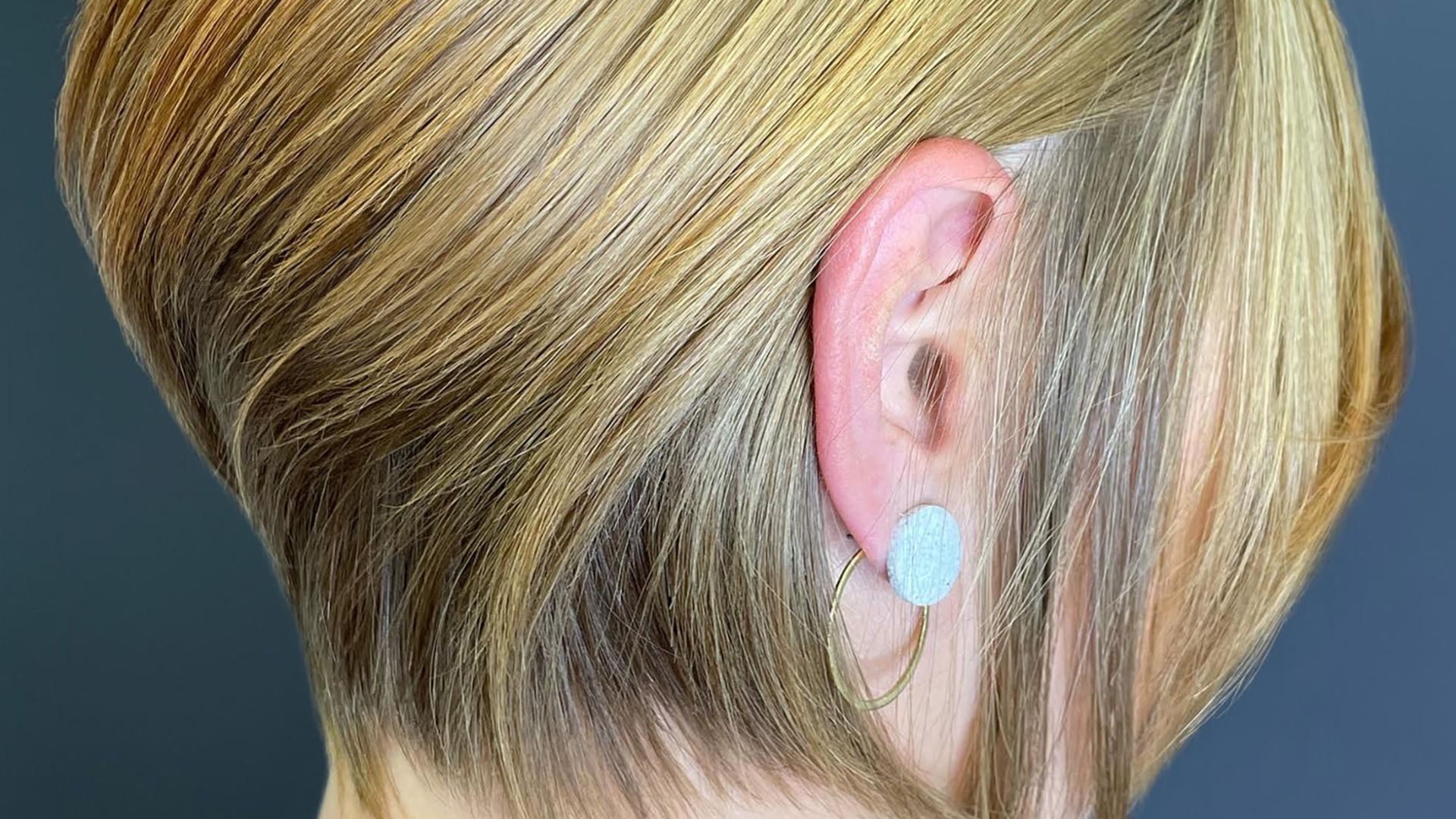
We think about hair the way an architect thinks about a building. On a building, the windows and the doors all line up. A good haircut has that same hidden order. Strong angles. Clean sections. The right amount of tension in the right places. Get those simple things right and together they look effortless.
Our signature Cleo cut works this way. Instead of staring at the whole head and feeling overwhelmed, we split it into zones and treat each one on its own. Then we point the angles at what you want people to notice. Your eyes. Your cheekbones. Your mouth. A fringe or a length can lift a feature or soften one.
It helps to be honest about what we can and cannot change. We can change the length in each zone, the weight, and where the volume sits. We cannot change how much hair grows from your scalp, the angle it grows at, or your natural texture, unless we are perming it. We start there. With the truth.
Will Short Hair Suit Me?
Forget the old face shape charts. It is really about balance. If your shoulders are broad next to the size of your head, long hair can stretch you wider. Bringing the hair up and in can draw you back and slim the line. If your shoulders are narrow, lifting the hair off can give you height and stature.
A strong jaw does not rule short hair out. Put a hard line on it and it can look helmety. Soften it and it flatters. The skill is placing the right pieces in the right spots, to show off what you love and quietly play down what you do not.
Want ideas to bring in? Have a look through our pixie cut inspiration board, or our creative wolf cut board if you fancy more texture and edge.
I Want to Go Short, But Not That Haircut
This is the thing we hear most. “I want to go short. I just do not want the haircut women my age seem to get.” We hear you. There are a lot of dull, ageing short cuts out there. That is not this.
A sharp, refined short cut is striking, especially with grey or salt and pepper hair. It just needs keeping fresh. And if you are growing out your colour, going shorter speeds the whole thing up.
It also fixes a colour problem. Grey is cool. Most colour is warm. When you try to cover grey, you can end up with dark and light from the salt and pepper, and warm and cool fighting each other. Four things pulling against each other at once. Cutting it shorter clears that faster, and looks more flattering while you get there.
Short hair here is about feeling like yourself again. Waking up, looking in the mirror, and knowing you look great. That is the whole point.
For looks that feel sharp, not ageing, see our short haircuts for women over 50 board on Pinterest.
Is Short Hair Good for Fine or Thinning Hair?
Short hair can make fine hair look thicker, not thinner. When hair is long, the weight and the split ends on the ends drag it down and pull on the root. That exposes the scalp and makes hair look thinner than it really is.
Take the length off and you release that tension. You get height, movement and volume that cover the scalp and read as fuller.
It comes down to how your hair grows. Hair grows in phases. A strong growing phase can run for years and reach your waist. A weaker one may stall at, say, the jaw, leaving fine, wispy ends that are heavier than they look. If that sounds like you, going shorter usually helps.
What If I Want to Grow It Out Again?
Short hair is not a trap. There is a simple way through it.
The back grows fastest, under the occipital bone, and that is the bit that starts to feel heavy first. The part you actually want to grow is the top, between your fringe and that back bone. So as it grows, we keep tidying the back until the top catches up and it can all move together.
Do You Cut Men’s Short Hair?
Hair is hair. We cut it to fit you. If you want a quick skin fade that grows out in a week, a good barber at twenty to thirty pounds is fine. If you want something softer and more refined, which is where a lot of the trends are heading, a stylist is the better call.
You also get the service. A proper hour. A booked appointment that is actually there for you. And someone who is not lost the moment the hair is too long for clippers.
For a few ideas, browse our men’s short haircut board on Pinterest.
Take the free NOCO Hair Score and get a clear picture of where your hair is and what it needs.
Take the Free Hair ScoreCommon Questions About Short Haircuts
Where can I get a good short haircut in Bristol?
At NOCO Hair on Whiteladies Road. Every short cut starts with a consultation, so we read your hair and your features before we pick up the scissors. Ask about the Cleo cut, our signature short style.
Will short hair suit me?
If you wear your hair up most days, you very likely suit it. Beyond that it is about balance, your shoulders against your head, and softening or sharpening your features. We talk it through before anything is cut.
Is short hair ageing?
No, when it is cut right. A short cut looks ageing when too much weight is left low at the back, under the occipital bone. Take that weight away and a short cut looks sharp and fresh.
Is short hair good for fine or thinning hair?
Often yes. Removing length releases the weight that drags the root and exposes the scalp. You get more height and volume, which reads as fuller hair.
How long does it take to grow out a short haircut?
Hair grows about half an inch a month. With a plan and a few tidy ups along the way, you can grow it out smoothly without the awkward stages.
Yes, a few salons in Bristol do perms. We are not one of them. Not because we cannot. Because of what a perm does to your hair. Read this first, then choose well. By the end you will know how a perm works, who it suits, and what to ask before you book anyone.
What a Perm Actually Does
Your hair gets its shape from tiny links inside each strand. Think of them like the threads that hold a rope together.
Two kinds matter here. The first kind are strong. They are called disulfide bonds. They set the natural shape of your hair, whether it is straight, wavy or curly. These bonds are hard to break. You need a chemical to do it.
The second kind are weaker. They are called hydrogen bonds. Water and heat can break these. That is what happens every time you use straighteners or a curling iron.
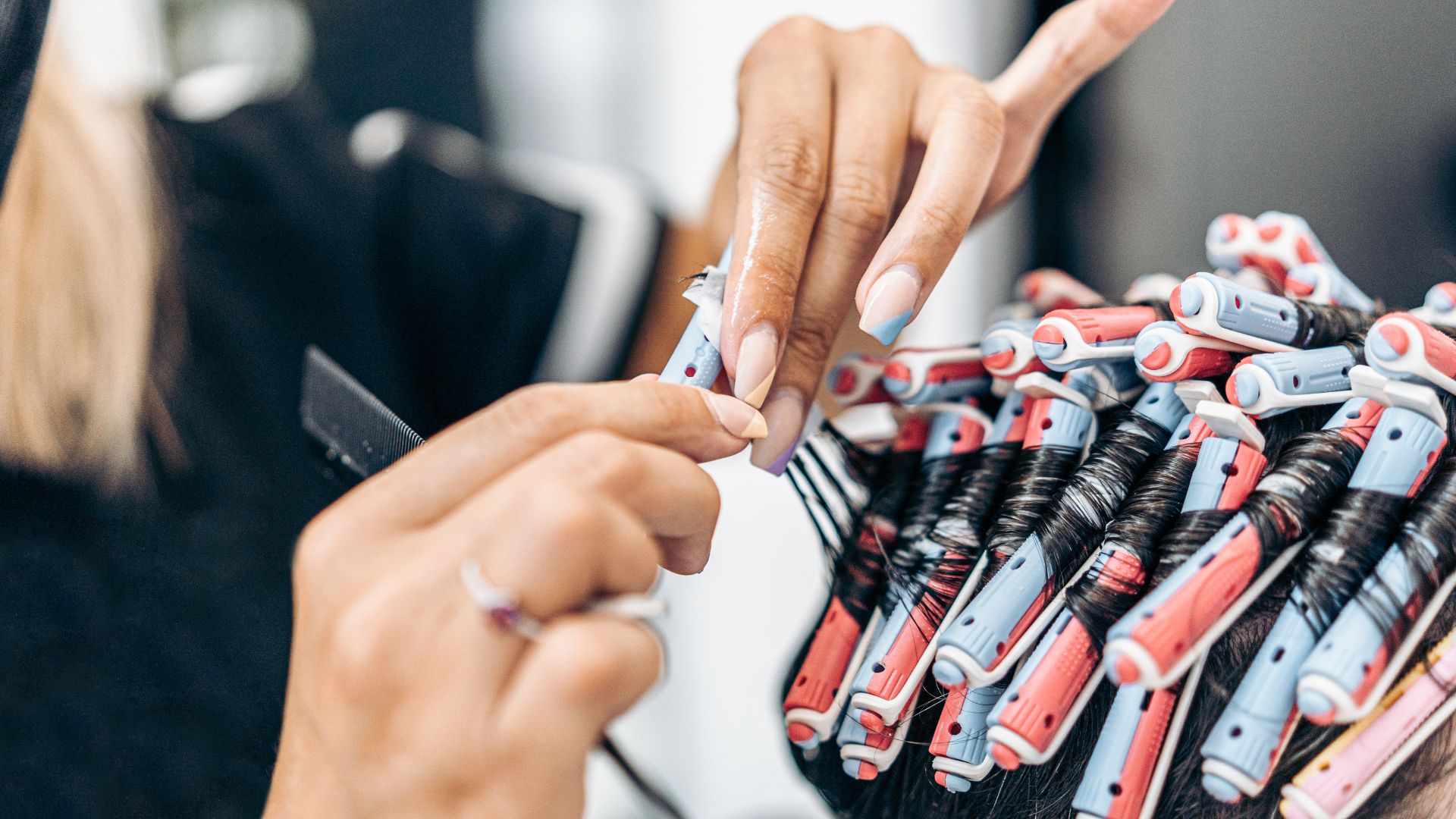
A perm works on the strong bonds. A perming lotion, usually one called ammonium thioglycolate, goes onto the hair. It breaks open those strong disulfide bonds. The hair is wrapped around rods. Then a second lotion, the neutraliser, sets the bonds again in a new shape. The curl is now locked in. It does not wash out.
Heat Styling Does the Same Job, Gently
Here is the part most people do not know.
When you curl your hair with a hot tool, you break the weaker hydrogen bonds. The hair holds the new shape until water or damp air resets it. No chemicals. No lasting damage.
So you can get a curl two ways. One is permanent and harsh. One is temporary and kind to your hair. For most people, the gentle way is the better way.
The Pros of a Perm
A perm has a few real upsides. You get curl or wave with no daily styling. You wake up and it is there. For people with very straight, fine hair, it can add body that is hard to get any other way. And it lasts for months.
There is a reason it is having a moment again. A lot of young men are asking for it. The skin fade with a perm on top, the look you see on footballers, is everywhere right now. On short hair, that works well. Here is why.
The Cons, and Why Long Hair Is the Problem
A perm changes your hair for good. As your hair grows, the new growth comes through straight. The curl stays on the older lengths.
On short hair this is fine. It grows out fast, you get it cut, and the permed hair is gone.
On long hair it is a different story. The roots grow in straight while the ends stay curly. After a few months you have two textures on one head. Straight at the top, curly at the bottom.
To fix it, you would perm it again. But now you hit the real risk. The second perm has to go over hair that has already been through the chemical once. You are breaking bonds that are already weak. That is when hair starts to snap and feel rough.
Why We Say No at NOCO
We build everything around hair health first. Care and condition come before anything else.
A service that weakens your hair, and gets riskier every time you repeat it, does not fit how we work. We would rather give you the look you want in a way that keeps your hair strong.
That usually means a great cut and the right styling. Most people who want a perm really want one thing. Volume. Or movement. Both can be done without touching the strong bonds in your hair.
What to Look For If You Still Want a Perm in Bristol
A perm is your choice. If you want one, that is completely fine. For the short footballer perm, a barber is your best bet. For a classic set on longer hair, look for a traditional salon. Wherever you go, choose carefully. Here is what to ask.
If a salon says yes to everything with no questions, be careful. The questions are a good sign.
Take the free NOCO Hair Score and get a clear picture of where your hair is and what it needs.
Take the Free Hair ScoreCommon Questions About Perms
Do you do perms at NOCO Hair?
No. We do not offer perms. We focus on hair health, and perms break the strong bonds inside your hair. We are happy to help you get volume or curl in a kinder way.
Where can I get a good perm in Bristol?
A few salons and barbers still offer them. For the short footballer perm, a barber is your best bet. For a classic set on longer hair, look for a traditional salon. Either way, use the checklist above. Ask for a test, ask about your hair length, and ask how they protect the condition.
Are perms bad for your hair?
One perm on short hair is usually fine. The risk grows on long hair. And it grows again every time you repeat the treatment over hair that has already been permed.
What is the footballer perm everyone is asking for?
It is a short skin fade with loose curls on top. Because the hair is short, it grows out cleanly. That makes it a lower risk look.
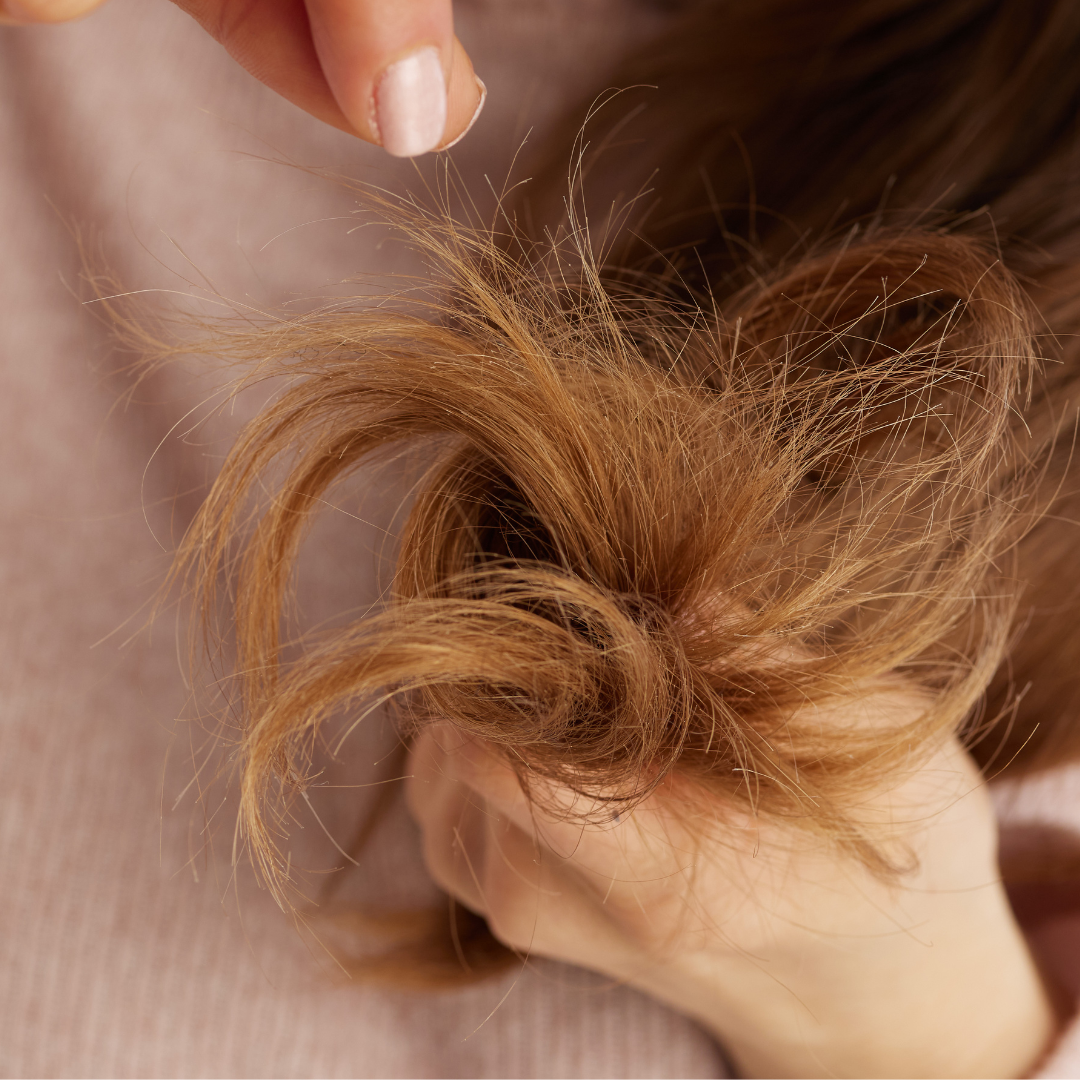
Frizz is not a hair type problem. It is a moisture problem. When the cuticle on the outside of your hair lifts, water gets in and out where it should not. Get those three things right and the frizz settles down on its own.
Why hair goes frizzy in the first place
Think of the cuticle on your hair like roof tiles. When the tiles lie flat, water stays out, light reflects, and hair looks smooth and shiny. When the tiles lift, water gets in, the inside of the hair swells, and you get that puffy, dry, frizzy look.
Summer makes this worse. Heat, humidity, sun, salt, and chlorine all lift the cuticle. The good news is the fix is simple. It comes down to three things you do at home.
Wash and Condition It Right
Most people get this part wrong. Use two shampoos when you wash your hair, then towel dry before you put conditioner on.
The first shampoo opens up the cuticle and pulls off product, oil, and dirt. The second shampoo gets in there properly and cleans the hair itself. Then wring it out and towel dry it before the conditioner goes on.
That step matters. If the hair is soaking wet, the conditioner just slides off. Towel dry first and the conditioner can do its job, which is to smooth those roof tiles back down so the hair feels soft and looks shiny from root to tip.
Dry It Properly With Heat
This one surprises people. The latest research shows that drying your hair fully with a hairdryer is better for it than letting it air dry.
When hair is left wet for a long time, water sits inside the cortex, which is the strong middle layer of the hair. That swelling causes tiny cracks and the hair loses strength. Dry it properly and you protect the cortex.
Use a medium heat setting. Hold the hairdryer about 15 cm away from your hair. Get it 100% dry. Not damp. Not nearly there. Properly dry.
Use an Oil or Leave-In Conditioner
Oils and water do not mix. Think of olive oil and balsamic vinegar in a bowl. They separate. Hair works the same way.
When you put oil on your hair, it pushes water out and seals the cuticle down. Water cannot get back in to swell the cortex. The hair stays smooth, the scalp stays calm, and the frizz settles.
Leave-in conditioners do the same job. They sit on the hair, smooth the cuticle, and protect it through the day. We use Kerastase at NOCO because it works. But the principle is what matters. Use something. Every time you wash.
Put it all together
- Two shampoos. Towel dry. Then condition.
- Dry the hair fully on medium heat, 15 cm away.
- Finish with an oil or leave-in conditioner every wash.
Do those three things and the frizz settles on its own. No new shampoo needed. No magic product. Just the right order and a bit of attention.
Take the free NOCO Hair Score and get a clear picture of where your hair is and what it needs.
Take the Free Hair ScoreWhen to come in
If your hair has been feeling dry and frizzy and the home routine is not shifting it, it is worth getting it properly looked at. At NOCO we use the Kerastase K-Scan to see what is happening with your scalp and the condition of your hair before we recommend anything. Sometimes the answer is a treatment. Sometimes it is a small change at home. Either way, you leave knowing what to do.
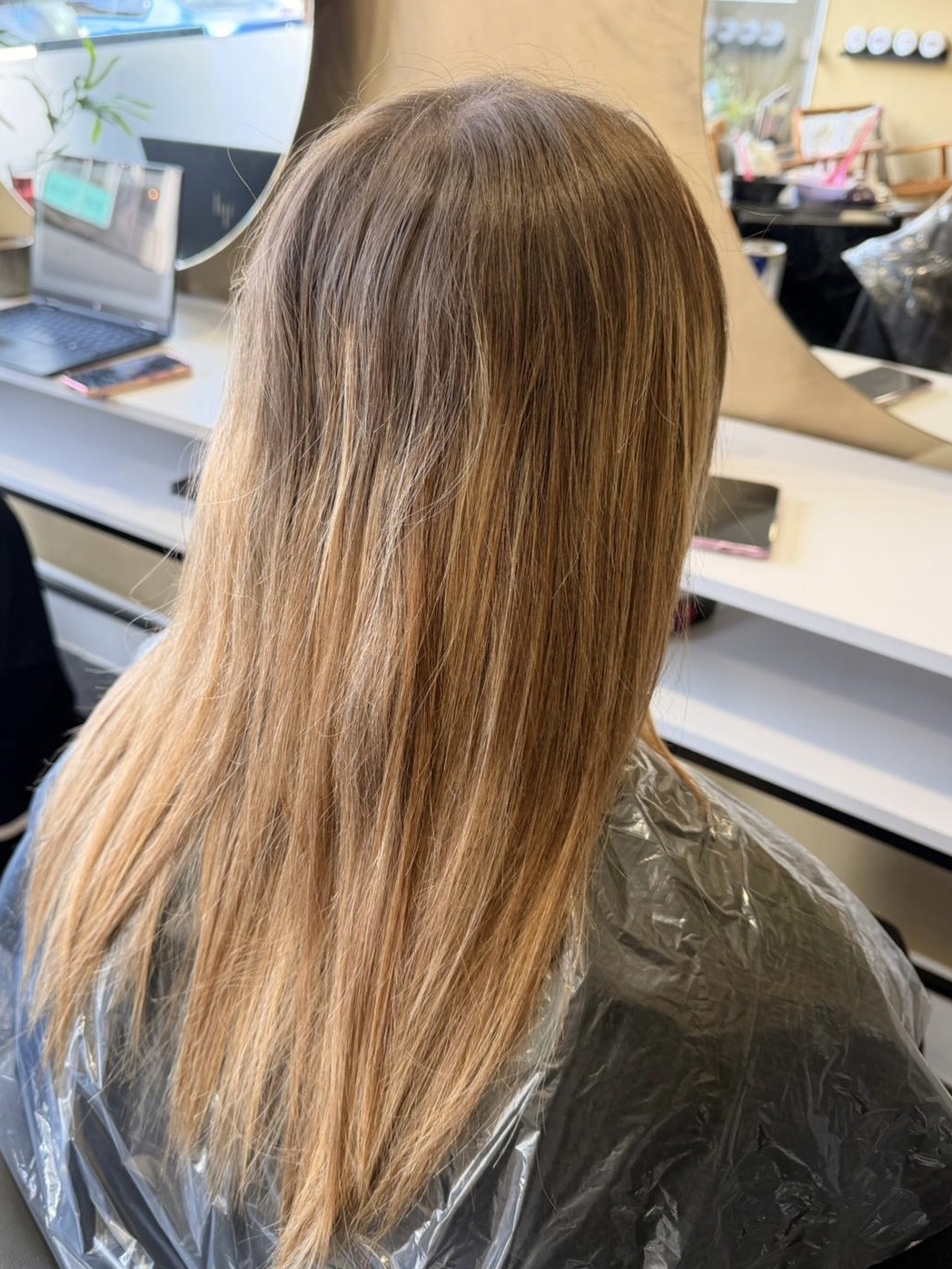 Before
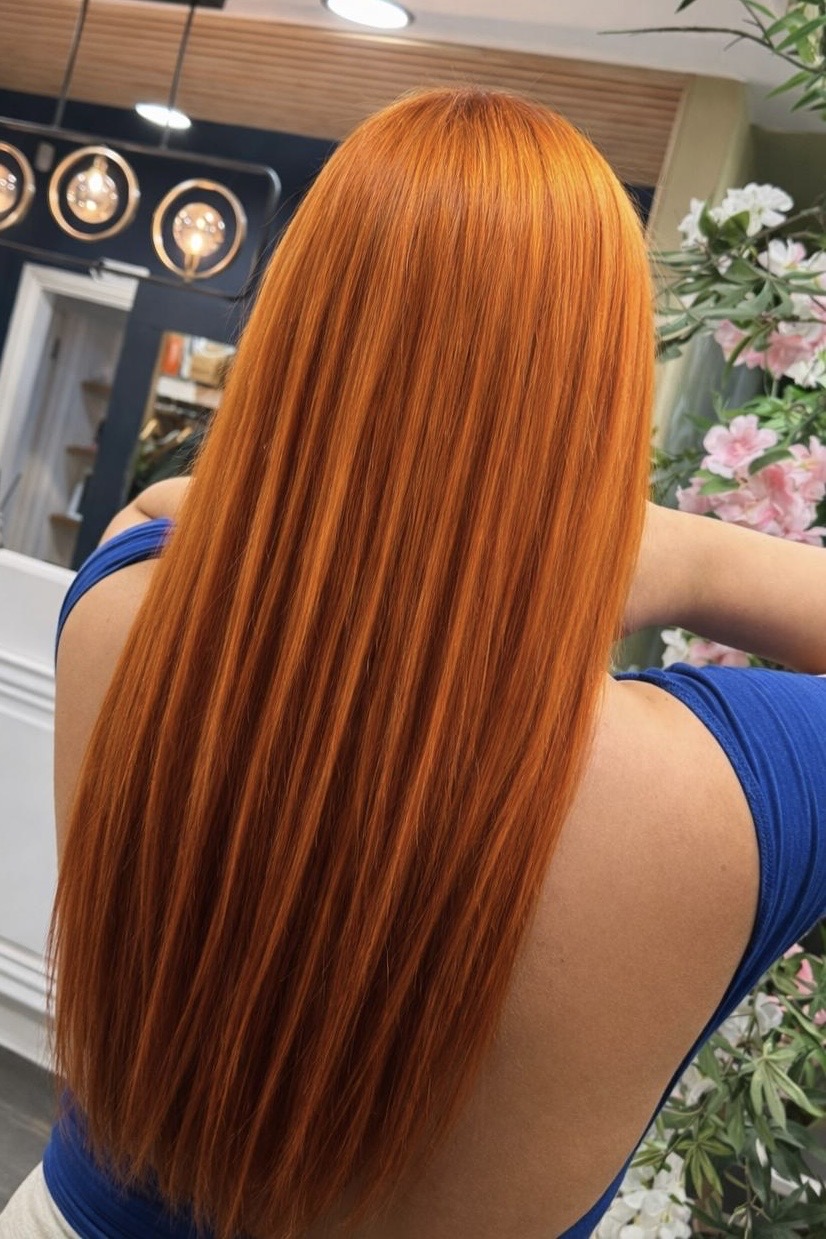 After
After
Phoebe’s hair was blonde but it did not feel like her. Not vibrant enough. Not thick enough. Not quite right. After an extensive consultation with Grace, the plan became clear. Bright copper colour, matched with tape-in extensions. This is what happened.
Where we started
Phoebe came in with a history of highlights that had grown into a soft balayage. Her hair was blonde and in good condition, but she felt it lacked vibrancy and volume. She wanted something with more presence. More colour. More her.
The challenge was getting there safely. To achieve a true copper result, we needed to lift the hair significantly while keeping it healthy enough to take the tone — and then match everything with tape-in extensions for the length and thickness Phoebe wanted.
That kind of result takes planning. Grace spent time in the consultation understanding exactly what Phoebe was asking for, what her hair could realistically achieve, and what the process would look like across the appointment.
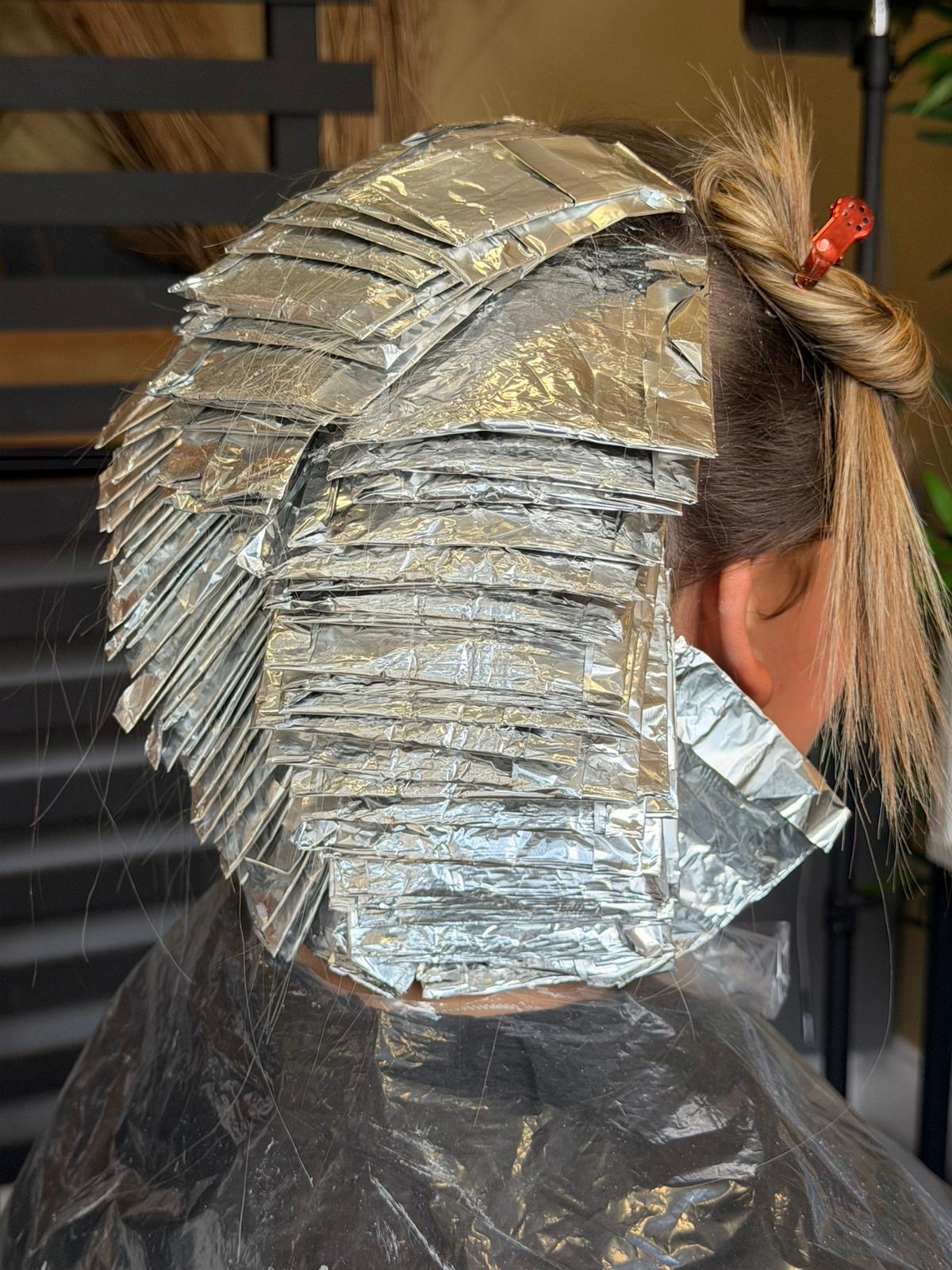
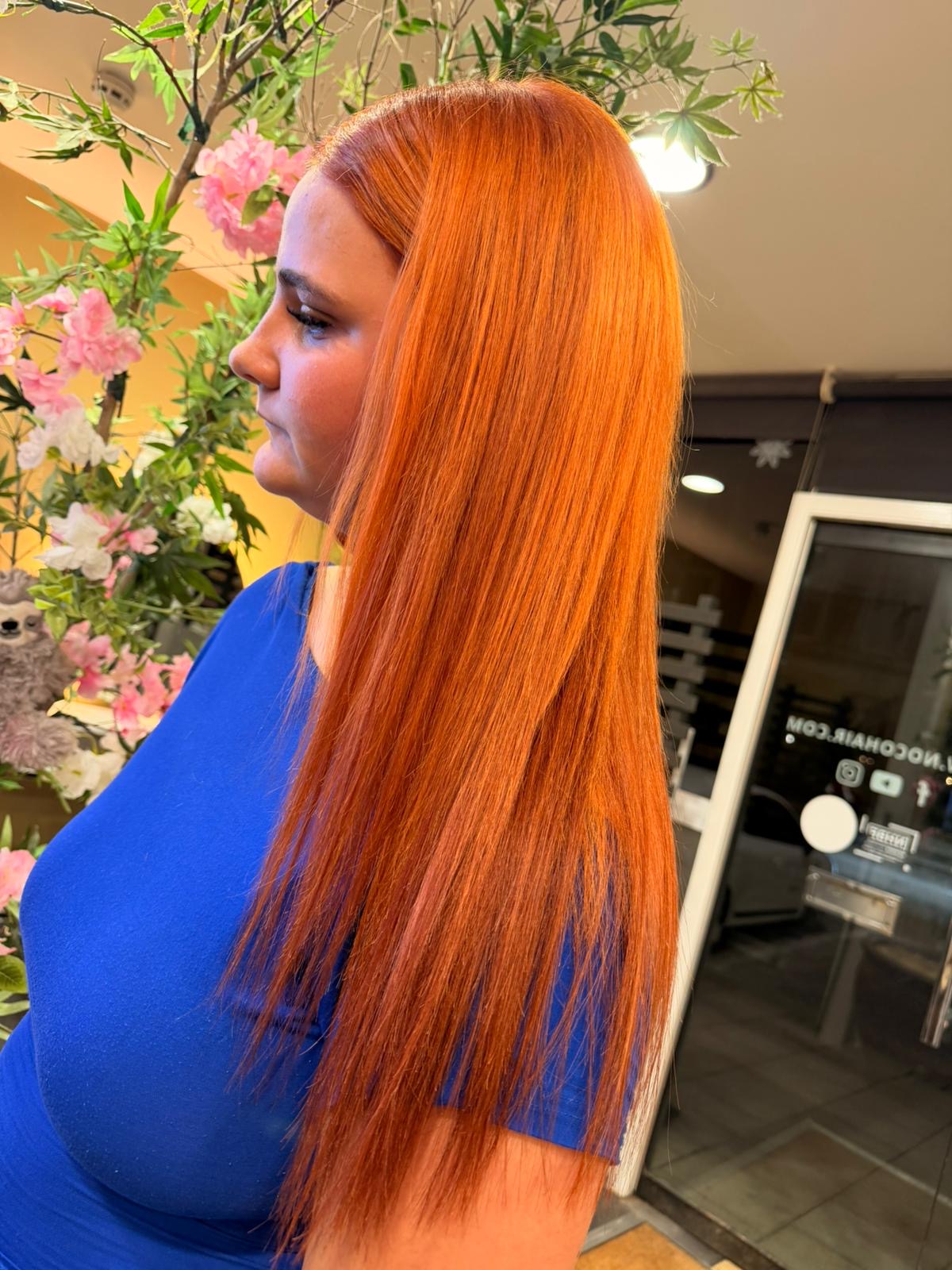
The technical process
This was a considered, multi-step colour appointment. Grace worked methodically through each stage to make sure the result was both vibrant and consistent.
The investment
A result like this involves multiple services delivered across a long appointment. Here is a transparent breakdown of what the appointment included.
Refer a friend and receive 25% off your next appointment.
Thinking about a colour change?
A transformation like this starts with an honest conversation. We look at your hair history, what your hair can realistically achieve, and what the process will actually involve. No surprises. No rushing. Just a clear plan before anything begins.
If you have been thinking about going warmer, brighter or more copper, a consultation at NOCO is the right first step.
Grace is a graduate colourist and stylist at NOCO Hair Bristol. This copper transformation demonstrates her ability to plan technically complex appointments and deliver results that genuinely exceed expectations.
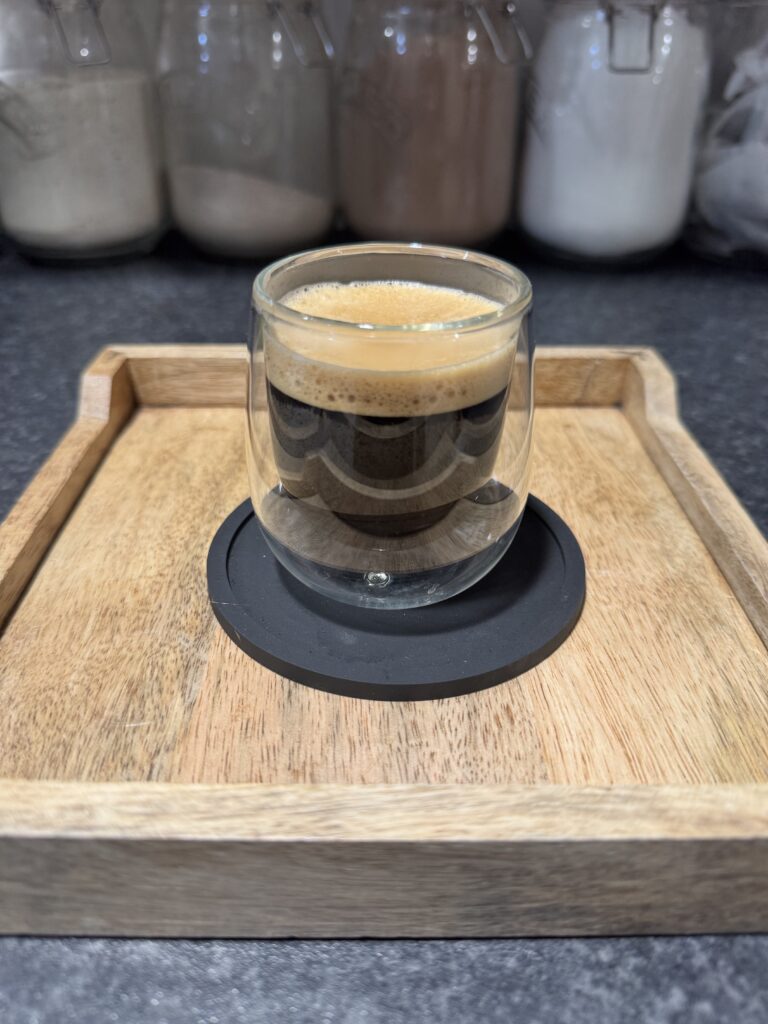
What happens on the outside is a reflection of what goes on on the inside. If your hair has been feeling more lank, thinner, or harder to manage, the answer is more likely to be in your diet than in a new shampoo.
You are currently viewing a placeholder content from YouTube. To access the actual content, click the button below. Please note that doing so will share data with third-party providers.
More InformationWhat Tim Spector actually said
Professor Tim Spector, founder of the Zoe nutrition programme and one of the UK’s leading voices on gut health, has talked extensively about the benefits of black coffee for the microbiome. His recommendation of three cups of black coffee a day is not about the caffeine. It is about the polyphenols in coffee that feed the beneficial bacteria in your gut.
A healthy microbiome means better nutrient absorption. And better nutrient absorption means the vitamins and minerals your hair follicles need are actually getting to where they need to go.
So does coffee actually help hair growth?
Indirectly, yes. The connection runs through your gut. If your gut health is in good shape and your body is absorbing nutrients properly, your hair benefits. Coffee, specifically black coffee without sugar or milk, contributes to that gut environment.
There is also separate research on topical caffeine and hair follicle stimulation, but that is a different conversation. For most people the simplest starting point is just drinking good quality black coffee regularly and paying attention to the broader diet picture.
What should you actually do?
If your hair has been feeling different lately, the question worth asking is not what shampoo to switch to. It is what has changed in your life in the last three to six months. Stress levels, diet, sleep, hormones. Hair growth cycles run on a delay of around three months, so what you are seeing now reflects what was happening then.
- Three cups of good quality black coffee a day if you tolerate caffeine well.
- Oily fish two to three times a week for omega-3 fatty acids that support scalp health.
- Reduce ultra processed food, which disrupts the gut environment that supports nutrient absorption.
- Get your iron and ferritin levels checked if you have noticed increased shedding. Low ferritin is one of the most common and most overlooked causes of hair loss in women.
Take the free NOCO Hair Score and get a clear picture of where your hair is and what it needs.
Take the Free Hair ScoreWhen to come in
If your hair has been changing and you are not sure why, the most useful thing you can do is have it properly assessed. At NOCO we use the Kerastase K-Scan to get a clear clinical picture of your scalp and hair condition before we recommend anything. It takes the guesswork out of it.
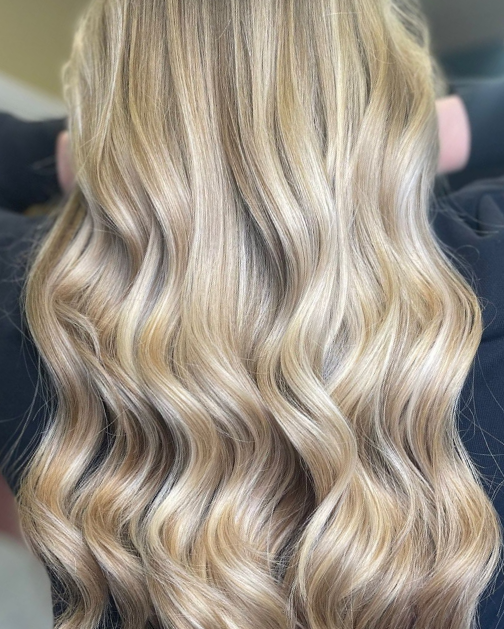
Grey blending is one of the fastest growing colour services we are seeing at NOCO right now. Here is what it actually is, who it works for, and why so many women in Bristol are making the switch.
What is grey blending?
Grey blending is a colour technique that works with your grey hair rather than against it. Instead of applying a single, solid colour to cover every grey strand, your stylist uses a combination of highlights, lowlights, and toning to weave your natural greys into a multitonal result that looks intentional, modern, and genuinely beautiful.
The result grows out softly with no harsh regrowth line. No dramatic roots appearing two weeks after your appointment. No feeling like you need to be back in the chair before you are ready.
It is not about going fully grey overnight. It is about giving your grey somewhere to live in your hair that looks considered rather than accidental.
Who is it for?
Grey blending works best if you are somewhere in the middle. Typically somewhere between 25% and 75% grey that classic salt and pepper stage where full coverage feels like a battle you are permanently losing.
It is also a strong option if you have been colouring for years and are starting to wonder whether there is a different way. A way that does not chain you to a four week cycle.
What does the process look like at NOCO?
Every grey blending appointment at NOCO starts with a consultation. We look at where your grey is concentrated, what your hair history looks like, and what your maintenance appetite actually is. There is no point designing something that requires you to be back every six weeks if your goal was to have more freedom.
As a L’Oréal partner salon, we have access to their full professional colour portfolio including the L’Oréal French Blending service a technique that uses a specific vertical weaving application to create natural, multidimensional grey blending rather than flat coverage. It is one of the most technically refined approaches to this kind of work available.
Depending on where your hair is starting from, the result might be achievable in a single appointment. If you have been using permanent colour for a long time, we may suggest a gradual approach over two or three visits to make sure the transition looks natural rather than patchy.
Why is everyone talking about grey blending in 2026?
Because the conversation around grey hair has shifted. What used to feel like something to hide now feels like something to own.
Grey blending sits right in the middle of that shift. It is not a dramatic statement. It is a quiet, considered decision that tends to make people look more rested, more themselves, and paradoxically more youthful because the colour is working with their natural tones rather than fighting them.
What about maintenance at home?
Grey blending is low maintenance at the salon but your hair will thank you for a little care at home.
Take the free NOCO Hair Score and find out exactly what your hair needs before you book anything.
Take the Free Hair ScoreThinking about grey blending in Bristol?
The best place to start is a conversation. Book a consultation at NOCO and we will give you an honest picture of what grey blending could look like for your hair specifically, what the process involves, and what it would cost. No commitment required.