


The NOCO Go app, our NOCO Hair booking app, lets you book, move or check your visit whenever it suits you, even at midnight when you suddenly remember. Two minutes of setup and you are away.
Step 1. Download the app
Search NOCO Hair in the App Store or Google Play and look for NOCO Go, or tap this link on your phone and it will take you to the right store automatically: Download the NOCO Go app.
Step 2. Get logged in. This is the bit that matters
Been to NOCO before? Your details are already in our system, so do not create a new account. Tap Forgot password, enter the email we have for you, and set your password. That is it, you are in.
New to NOCO? Tap Create account and you are away.

Two doors. Been before? Yours is Login, then Forgot password.

Been before? This is your button.
Step 3. Book your visit
Choose your service, your stylist and your time. Done in under a minute. You can move or check your appointment from the same place whenever you need to.
Questions we hear a lot

Yes, you can get a great short haircut in Bristol. The hard part is finding someone you trust to do it. Most people who hate their short cut were not given the wrong length. They were given the wrong haircut. Here is the difference, and how we get it right.
Quick reassurance before anything else. If you tie your hair up most days, you almost certainly suit short hair. The reason you tie it up is the same reason short hair works. It lifts the hair off your neck, makes you look more elegant, and gives you a longer line. A good short cut gives you that every morning, without the hair tie.
Why So Many Short Cuts Go Wrong
Most people carry the weight of their hair low at the back, under the occipital bone. That is the bone you can feel at the back of your head. Leave too much hair sitting there and the cut feels heavy. It is the single biggest reason a short cut looks ageing or frumpy.
A good stylist also reads your hair before they cut. Where it swirls. Where the crown sits. Where it wants to stick up. Cut against those and the hair fights you every morning.
The last problem is autopilot. A lot of stylists cut the shape they always cut, not the shape in front of them. That is how people end up wearing what feels like someone else’s hair.
A Good Haircut Is Architecture
We think about hair the way an architect thinks about a building. On a building, the windows and the doors all line up. A good haircut has that same hidden order. Strong angles. Clean sections. The right amount of tension in the right places. Get those simple things right and together they look effortless.
Our signature Cleo cut works this way. Instead of staring at the whole head and feeling overwhelmed, we split it into zones and treat each one on its own. Then we point the angles at what you want people to notice. Your eyes. Your cheekbones. Your mouth. A fringe or a length can lift a feature or soften one.
It helps to be honest about what we can and cannot change. We can change the length in each zone, the weight, and where the volume sits. We cannot change how much hair grows from your scalp, the angle it grows at, or your natural texture, unless we are perming it. We start there. With the truth.
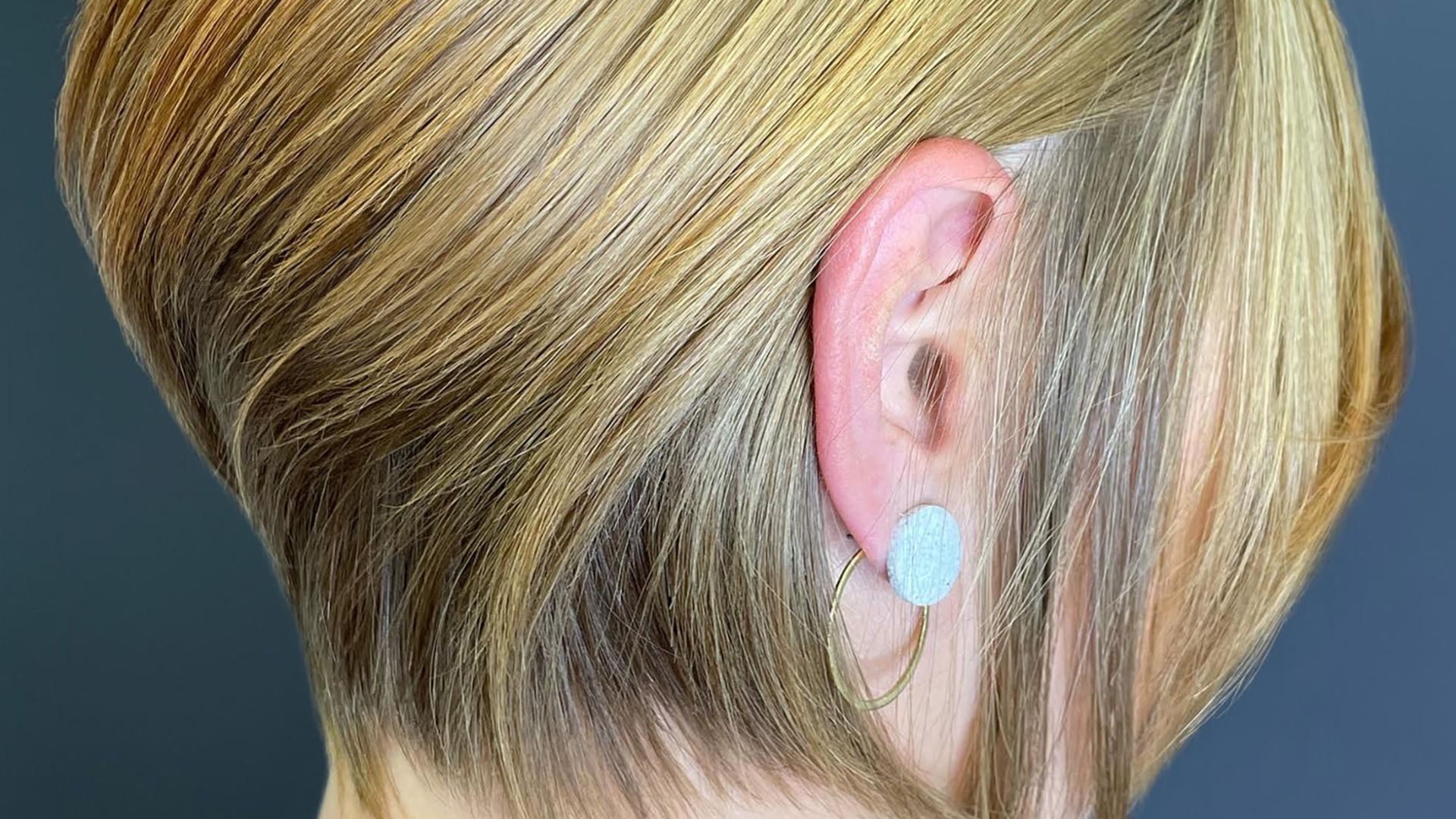
Will Short Hair Suit Me?
Forget the old face shape charts. It is really about balance. If your shoulders are broad next to the size of your head, long hair can stretch you wider. Bringing the hair up and in can draw you back and slim the line. If your shoulders are narrow, lifting the hair off can give you height and stature.
A strong jaw does not rule short hair out. Put a hard line on it and it can look helmety. Soften it and it flatters. The skill is placing the right pieces in the right spots, to show off what you love and quietly play down what you do not.
Want ideas to bring in? Have a look through our pixie cut inspiration board, or our creative wolf cut board if you fancy more texture and edge.
I Want to Go Short, But Not That Haircut
This is the thing we hear most. “I want to go short. I just do not want the haircut women my age seem to get.” We hear you. There are a lot of dull, ageing short cuts out there. That is not this.
A sharp, refined short cut is striking, especially with grey or salt and pepper hair. It just needs keeping fresh. And if you are growing out your colour, going shorter speeds the whole thing up.
It also fixes a colour problem. Grey is cool. Most colour is warm. When you try to cover grey, you can end up with dark and light from the salt and pepper, and warm and cool fighting each other. Four things pulling against each other at once. Cutting it shorter clears that faster, and looks more flattering while you get there.
Short hair here is about feeling like yourself again. Waking up, looking in the mirror, and knowing you look great. That is the whole point.
For looks that feel sharp, not ageing, see our short haircuts for women over 50 board on Pinterest.
Is Short Hair Good for Fine or Thinning Hair?
Short hair can make fine hair look thicker, not thinner. When hair is long, the weight and the split ends on the ends drag it down and pull on the root. That exposes the scalp and makes hair look thinner than it really is.
Take the length off and you release that tension. You get height, movement and volume that cover the scalp and read as fuller.
It comes down to how your hair grows. Hair grows in phases. A strong growing phase can run for years and reach your waist. A weaker one may stall at, say, the jaw, leaving fine, wispy ends that are heavier than they look. If that sounds like you, going shorter usually helps.
What If I Want to Grow It Out Again?
Short hair is not a trap. There is a simple way through it.
The back grows fastest, under the occipital bone, and that is the bit that starts to feel heavy first. The part you actually want to grow is the top, between your fringe and that back bone. So as it grows, we keep tidying the back until the top catches up and it can all move together.
Do You Cut Men’s Short Hair?
Hair is hair. We cut it to fit you. If you want a quick skin fade that grows out in a week, a good barber at twenty to thirty pounds is fine. If you want something softer and more refined, which is where a lot of the trends are heading, a stylist is the better call.
You also get the service. A proper hour. A booked appointment that is actually there for you. And someone who is not lost the moment the hair is too long for clippers.
For a few ideas, browse our men’s short haircut board on Pinterest.
Take the free NOCO Hair Score and get a clear picture of where your hair is and what it needs.
Take the Free Hair ScoreCommon Questions About Short Haircuts
Where can I get a good short haircut in Bristol?
At NOCO Hair on Whiteladies Road. Every short cut starts with a consultation, so we read your hair and your features before we pick up the scissors. Ask about the Cleo cut, our signature short style.
Will short hair suit me?
If you wear your hair up most days, you very likely suit it. Beyond that it is about balance, your shoulders against your head, and softening or sharpening your features. We talk it through before anything is cut.
Is short hair ageing?
No, when it is cut right. A short cut looks ageing when too much weight is left low at the back, under the occipital bone. Take that weight away and a short cut looks sharp and fresh.
Is short hair good for fine or thinning hair?
Often yes. Removing length releases the weight that drags the root and exposes the scalp. You get more height and volume, which reads as fuller hair.
How long does it take to grow out a short haircut?
Hair grows about half an inch a month. With a plan and a few tidy ups along the way, you can grow it out smoothly without the awkward stages.
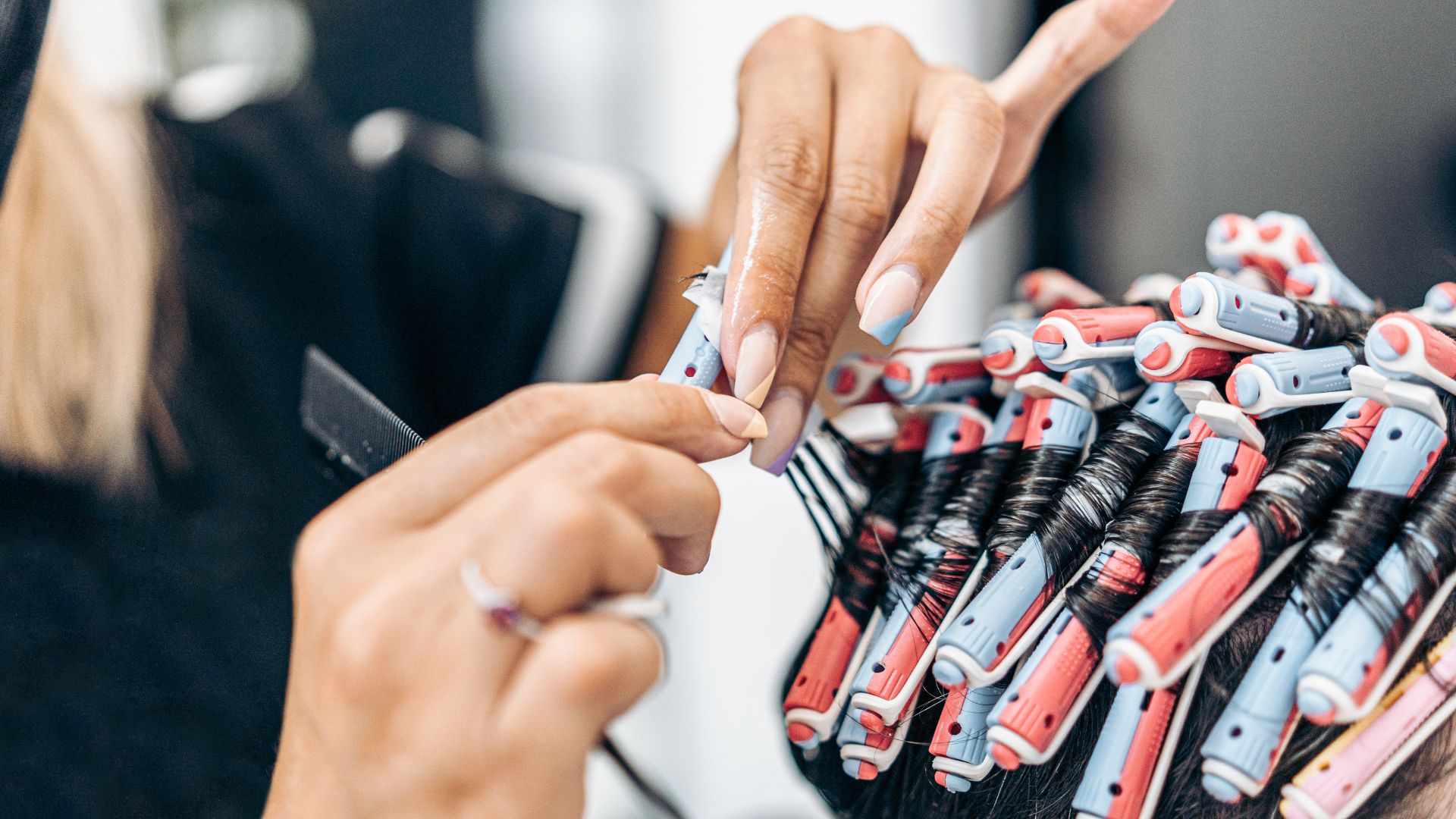
Yes, a few salons in Bristol do perms. We are not one of them. Not because we cannot. Because of what a perm does to your hair. Read this first, then choose well. By the end you will know how a perm works, who it suits, and what to ask before you book anyone.
What a Perm Actually Does
Your hair gets its shape from tiny links inside each strand. Think of them like the threads that hold a rope together.
Two kinds matter here. The first kind are strong. They are called disulfide bonds. They set the natural shape of your hair, whether it is straight, wavy or curly. These bonds are hard to break. You need a chemical to do it.
The second kind are weaker. They are called hydrogen bonds. Water and heat can break these. That is what happens every time you use straighteners or a curling iron.
A perm works on the strong bonds. A perming lotion, usually one called ammonium thioglycolate, goes onto the hair. It breaks open those strong disulfide bonds. The hair is wrapped around rods. Then a second lotion, the neutraliser, sets the bonds again in a new shape. The curl is now locked in. It does not wash out.
Heat Styling Does the Same Job, Gently
Here is the part most people do not know.
When you curl your hair with a hot tool, you break the weaker hydrogen bonds. The hair holds the new shape until water or damp air resets it. No chemicals. No lasting damage.
So you can get a curl two ways. One is permanent and harsh. One is temporary and kind to your hair. For most people, the gentle way is the better way.
The Pros of a Perm
A perm has a few real upsides. You get curl or wave with no daily styling. You wake up and it is there. For people with very straight, fine hair, it can add body that is hard to get any other way. And it lasts for months.
There is a reason it is having a moment again. A lot of young men are asking for it. The skin fade with a perm on top, the look you see on footballers, is everywhere right now. On short hair, that works well. Here is why.
The Cons, and Why Long Hair Is the Problem
A perm changes your hair for good. As your hair grows, the new growth comes through straight. The curl stays on the older lengths.
On short hair this is fine. It grows out fast, you get it cut, and the permed hair is gone.
On long hair it is a different story. The roots grow in straight while the ends stay curly. After a few months you have two textures on one head. Straight at the top, curly at the bottom.
To fix it, you would perm it again. But now you hit the real risk. The second perm has to go over hair that has already been through the chemical once. You are breaking bonds that are already weak. That is when hair starts to snap and feel rough.
Why We Say No at NOCO
We build everything around hair health first. Care and condition come before anything else.
A service that weakens your hair, and gets riskier every time you repeat it, does not fit how we work. We would rather give you the look you want in a way that keeps your hair strong.
That usually means a great cut and the right styling. Most people who want a perm really want one thing. Volume. Or movement. Both can be done without touching the strong bonds in your hair.
What to Look For If You Still Want a Perm in Bristol
A perm is your choice. If you want one, that is completely fine. For the short footballer perm, a barber is your best bet. For a classic set on longer hair, look for a traditional salon. Wherever you go, choose carefully. Here is what to ask.
If a salon says yes to everything with no questions, be careful. The questions are a good sign.
Take the free NOCO Hair Score and get a clear picture of where your hair is and what it needs.
Take the Free Hair ScoreCommon Questions About Perms
Do you do perms at NOCO Hair?
No. We do not offer perms. We focus on hair health, and perms break the strong bonds inside your hair. We are happy to help you get volume or curl in a kinder way.
Where can I get a good perm in Bristol?
A few salons and barbers still offer them. For the short footballer perm, a barber is your best bet. For a classic set on longer hair, look for a traditional salon. Either way, use the checklist above. Ask for a test, ask about your hair length, and ask how they protect the condition.
Are perms bad for your hair?
One perm on short hair is usually fine. The risk grows on long hair. And it grows again every time you repeat the treatment over hair that has already been permed.
What is the footballer perm everyone is asking for?
It is a short skin fade with loose curls on top. Because the hair is short, it grows out cleanly. That makes it a lower risk look.

Frizz is not a hair type problem. It is a moisture problem. When the cuticle on the outside of your hair lifts, water gets in and out where it should not. Get those three things right and the frizz settles down on its own.
Why hair goes frizzy in the first place
Think of the cuticle on your hair like roof tiles. When the tiles lie flat, water stays out, light reflects, and hair looks smooth and shiny. When the tiles lift, water gets in, the inside of the hair swells, and you get that puffy, dry, frizzy look.
Summer makes this worse. Heat, humidity, sun, salt, and chlorine all lift the cuticle. The good news is the fix is simple. It comes down to three things you do at home.
Wash and Condition It Right
Most people get this part wrong. Use two shampoos when you wash your hair, then towel dry before you put conditioner on.
The first shampoo opens up the cuticle and pulls off product, oil, and dirt. The second shampoo gets in there properly and cleans the hair itself. Then wring it out and towel dry it before the conditioner goes on.
That step matters. If the hair is soaking wet, the conditioner just slides off. Towel dry first and the conditioner can do its job, which is to smooth those roof tiles back down so the hair feels soft and looks shiny from root to tip.
Dry It Properly With Heat
This one surprises people. The latest research shows that drying your hair fully with a hairdryer is better for it than letting it air dry.
When hair is left wet for a long time, water sits inside the cortex, which is the strong middle layer of the hair. That swelling causes tiny cracks and the hair loses strength. Dry it properly and you protect the cortex.
Use a medium heat setting. Hold the hairdryer about 15 cm away from your hair. Get it 100% dry. Not damp. Not nearly there. Properly dry.
Use an Oil or Leave-In Conditioner
Oils and water do not mix. Think of olive oil and balsamic vinegar in a bowl. They separate. Hair works the same way.
When you put oil on your hair, it pushes water out and seals the cuticle down. Water cannot get back in to swell the cortex. The hair stays smooth, the scalp stays calm, and the frizz settles.
Leave-in conditioners do the same job. They sit on the hair, smooth the cuticle, and protect it through the day. We use Kerastase at NOCO because it works. But the principle is what matters. Use something. Every time you wash.
Put it all together
- Two shampoos. Towel dry. Then condition.
- Dry the hair fully on medium heat, 15 cm away.
- Finish with an oil or leave-in conditioner every wash.
Do those three things and the frizz settles on its own. No new shampoo needed. No magic product. Just the right order and a bit of attention.
Take the free NOCO Hair Score and get a clear picture of where your hair is and what it needs.
Take the Free Hair ScoreWhen to come in
If your hair has been feeling dry and frizzy and the home routine is not shifting it, it is worth getting it properly looked at. At NOCO we use the Kerastase K-Scan to see what is happening with your scalp and the condition of your hair before we recommend anything. Sometimes the answer is a treatment. Sometimes it is a small change at home. Either way, you leave knowing what to do.
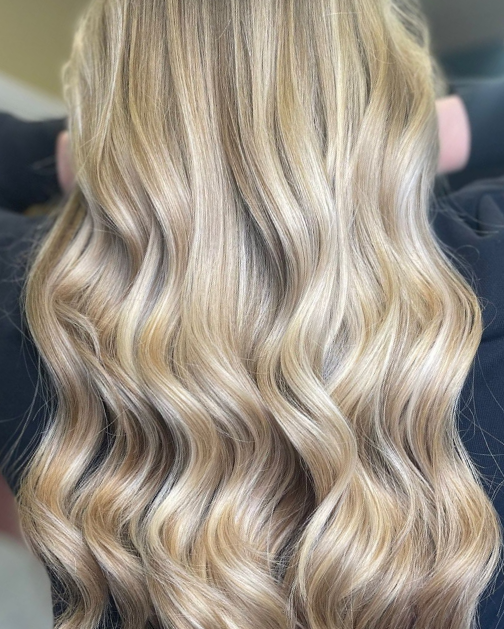
Grey blending is one of the fastest growing colour services we are seeing at NOCO right now. Here is what it actually is, who it works for, and why so many women in Bristol are making the switch.
What is grey blending?
Grey blending is a colour technique that works with your grey hair rather than against it. Instead of applying a single, solid colour to cover every grey strand, your stylist uses a combination of highlights, lowlights, and toning to weave your natural greys into a multitonal result that looks intentional, modern, and genuinely beautiful.
The result grows out softly with no harsh regrowth line. No dramatic roots appearing two weeks after your appointment. No feeling like you need to be back in the chair before you are ready.
It is not about going fully grey overnight. It is about giving your grey somewhere to live in your hair that looks considered rather than accidental.
Who is it for?
Grey blending works best if you are somewhere in the middle. Typically somewhere between 25% and 75% grey that classic salt and pepper stage where full coverage feels like a battle you are permanently losing.
It is also a strong option if you have been colouring for years and are starting to wonder whether there is a different way. A way that does not chain you to a four week cycle.
What does the process look like at NOCO?
Every grey blending appointment at NOCO starts with a consultation. We look at where your grey is concentrated, what your hair history looks like, and what your maintenance appetite actually is. There is no point designing something that requires you to be back every six weeks if your goal was to have more freedom.
As a L’Oréal partner salon, we have access to their full professional colour portfolio including the L’Oréal French Blending service a technique that uses a specific vertical weaving application to create natural, multidimensional grey blending rather than flat coverage. It is one of the most technically refined approaches to this kind of work available.
Depending on where your hair is starting from, the result might be achievable in a single appointment. If you have been using permanent colour for a long time, we may suggest a gradual approach over two or three visits to make sure the transition looks natural rather than patchy.
Why is everyone talking about grey blending in 2026?
Because the conversation around grey hair has shifted. What used to feel like something to hide now feels like something to own.
Grey blending sits right in the middle of that shift. It is not a dramatic statement. It is a quiet, considered decision that tends to make people look more rested, more themselves, and paradoxically more youthful because the colour is working with their natural tones rather than fighting them.
What about maintenance at home?
Grey blending is low maintenance at the salon but your hair will thank you for a little care at home.
Take the free NOCO Hair Score and find out exactly what your hair needs before you book anything.
Take the Free Hair ScoreThinking about grey blending in Bristol?
The best place to start is a conversation. Book a consultation at NOCO and we will give you an honest picture of what grey blending could look like for your hair specifically, what the process involves, and what it would cost. No commitment required.

A new study has ranked the City of Bristol as the second worst place in the UK to keep your hair healthy, with a risk score of 73.5 out of 100. North Somerset topped the list as the single worst local authority in the country. Bath and North East Somerset also made the top five worst areas. That is three locations in our region in the bottom five nationally.
We are not surprised. At NOCO Hair on Whiteladies Road, we have been seeing more clients coming in with hair loss, thinning and scalp concerns than ever before. Now we know part of the reason why.
What is actually causing it?
The study looked at three key environmental factors: water quality, air quality and UV levels. Bristol scored a perfect 10 out of 10 for poor water quality. That means the water coming out of your taps is one of the most damaging in the country for hair and scalp health.
Hard water contains high levels of minerals including calcium and magnesium. Over time these build up on the hair shaft and scalp, making hair feel rough, dry and brittle. They also interfere with how well shampoo and conditioner work, meaning your products are less effective than they should be.
The South West also ties for the highest UV levels in the UK alongside the South East. UV exposure damages the outer layer of the hair shaft and can accelerate pigment loss, meaning hair can go grey earlier than it otherwise would.
What you can do about it
You cannot change the water or the weather. But you can change how you manage your hair in response to the environment you live in. These are the things that make the most consistent difference.
The NOCO Hair Score gives you a number, a band and a clear next step. If you live in Bristol or the South West, this is worth doing.
Take the Free Hair ScoreWhen it is worth coming in
If you have been noticing more hair in the shower, thinning at the crown or temples, a drier or itchier scalp than usual, or hair that just does not feel the way it used to — it is worth having it properly assessed rather than guessing.
At NOCO Hair we use the Kerastase K-Scan consultation, which gives us a detailed clinical picture of your scalp and hair health before we recommend anything. It removes the guesswork and gives you a clear starting point. From there we can design a plan that actually addresses what your hair needs — not just a product recommendation off the shelf.
And if all else fails — you could always move to Scotland.
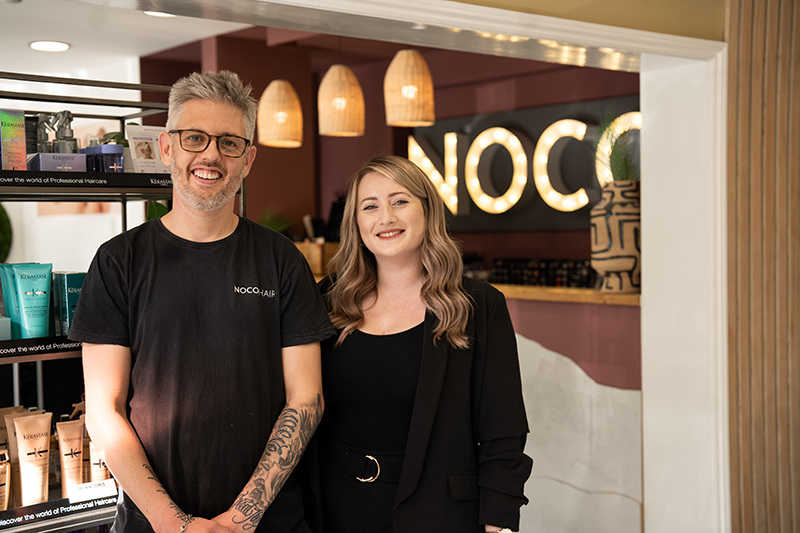
Hairdressing is as much about how you make someone feel as how they look. That has been true from day one at NOCO and it shapes every decision we make — about how we consult, how we train, how we give back, and what kind of place we want to be for the people of Bristol.
We opened NOCO Hair in 2018 with a clear idea of what we wanted to build. Not just a great salon. A place where people could step out of their hectic lives, leave their worries at the door and feel genuinely looked after. Hair, body and soul.
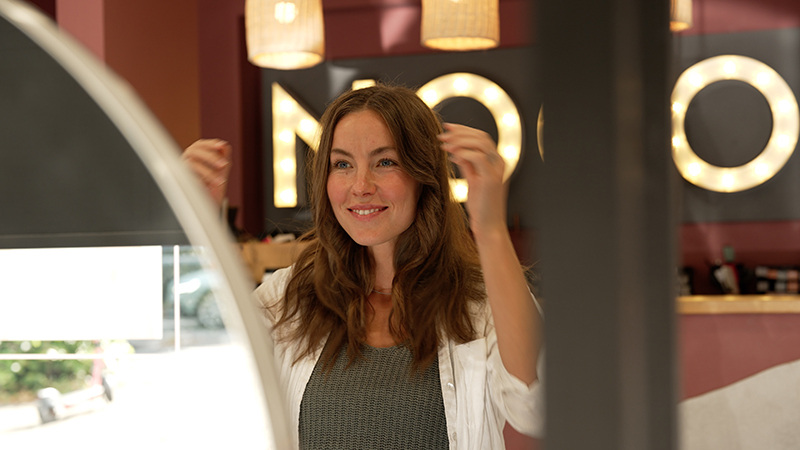
The relationships are the work
People sometimes ask what makes NOCO different. The honest answer is the relationships. The consultation is not a formality we go through before the real work starts. It is the real work. Understanding who someone is, what their hair has been through and what they actually want their life to look like — that is where everything begins.
We have had clients sit in the chair going through something enormous. A diagnosis. A bereavement. A life change they were not ready for. The haircut is almost beside the point in those moments. What matters is that they felt heard, looked after and, when they left, a little more like themselves.
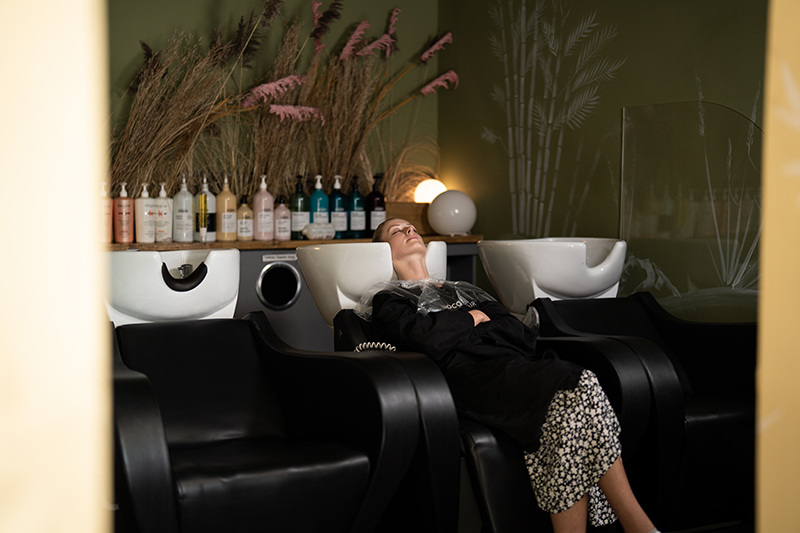
The wash. One of the most underrated moments in a salon visit.
Where it comes from
The Care with Hair campaign grew from a single moment that made everything clear. Years ago, I was invited to give a final haircut to one of my oldest clients, Megan, in hospice care. That visit changed how I think about what we do. A haircut is not just about how someone looks. It is about being present with another person. Seeing them. Caring for them at a moment that matters.
That one act became the foundation for everything Care with Hair has grown into — over £15,000 raised for Bristol charities, 300 free haircuts given to people who needed them most, and a team that genuinely believes business should do good, not just do well.
What the salon looks like now
The salon you walk into today on Whiteladies Road is the result of everything that has happened since 2018. The award within our first year. The lockdown that nearly ended it. The BBC Interior Design Masters transformation that gave the space its Japandi identity. And the team that has been built around a shared belief in doing this properly.
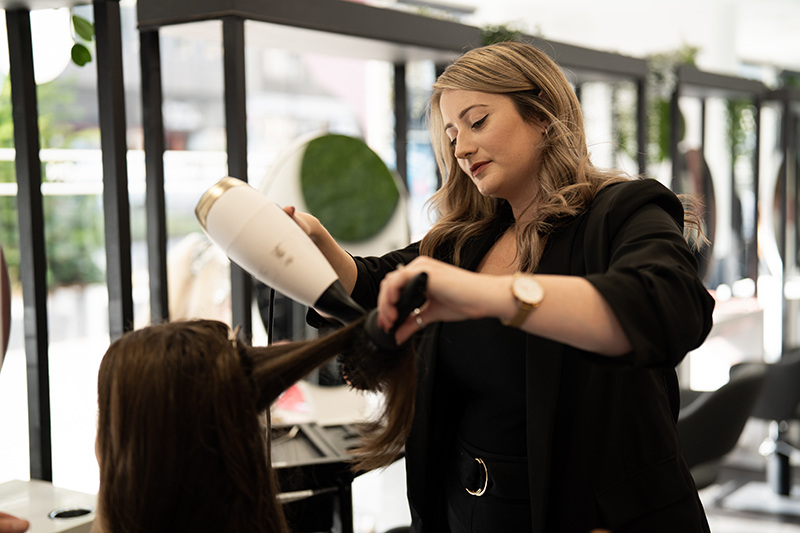
Corey Taylor at work. Co-founder, Managing Director and L’Oréal Colour Specialist.
Every detail in the salon is intentional. The drinks menu. The plants. The relaxation zone with its floor-to-ceiling bamboo mural. The massage chairs. The burnt orange, navy and yellow that run through the space. All of it exists to serve one idea: that when you are here, you should feel somewhere better than where you started.
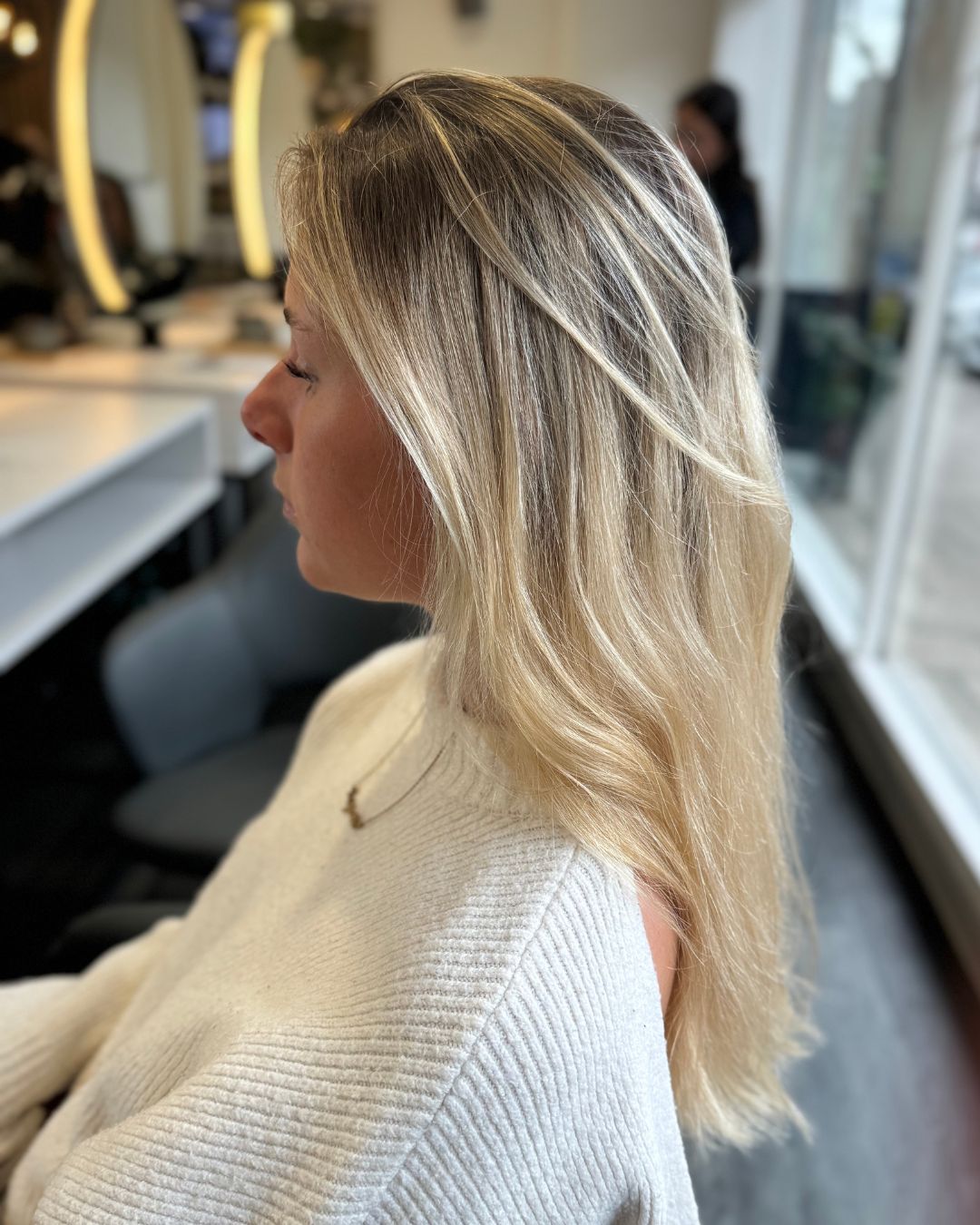
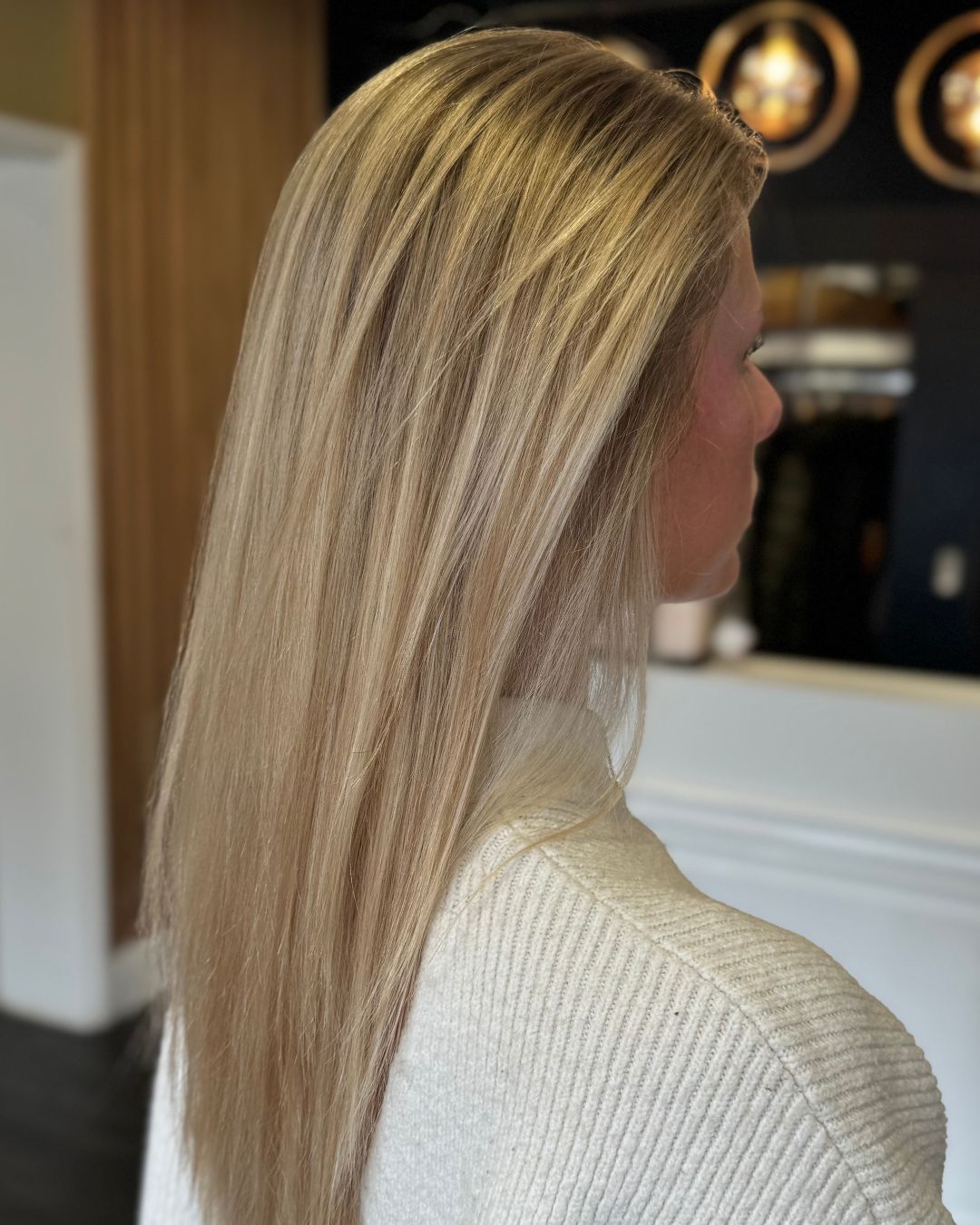
Blonde highlights in Bristol done well start with a conversation not a colour chart. For Lilybelle at NOCO Hair Bristol, that conversation changed everything. She did not just want lighter hair. She wanted to feel fresh, vibrant and confident walking out of the salon. Catching the light was the goal.
That is the conversation that shapes everything that follows.
Where she was starting from
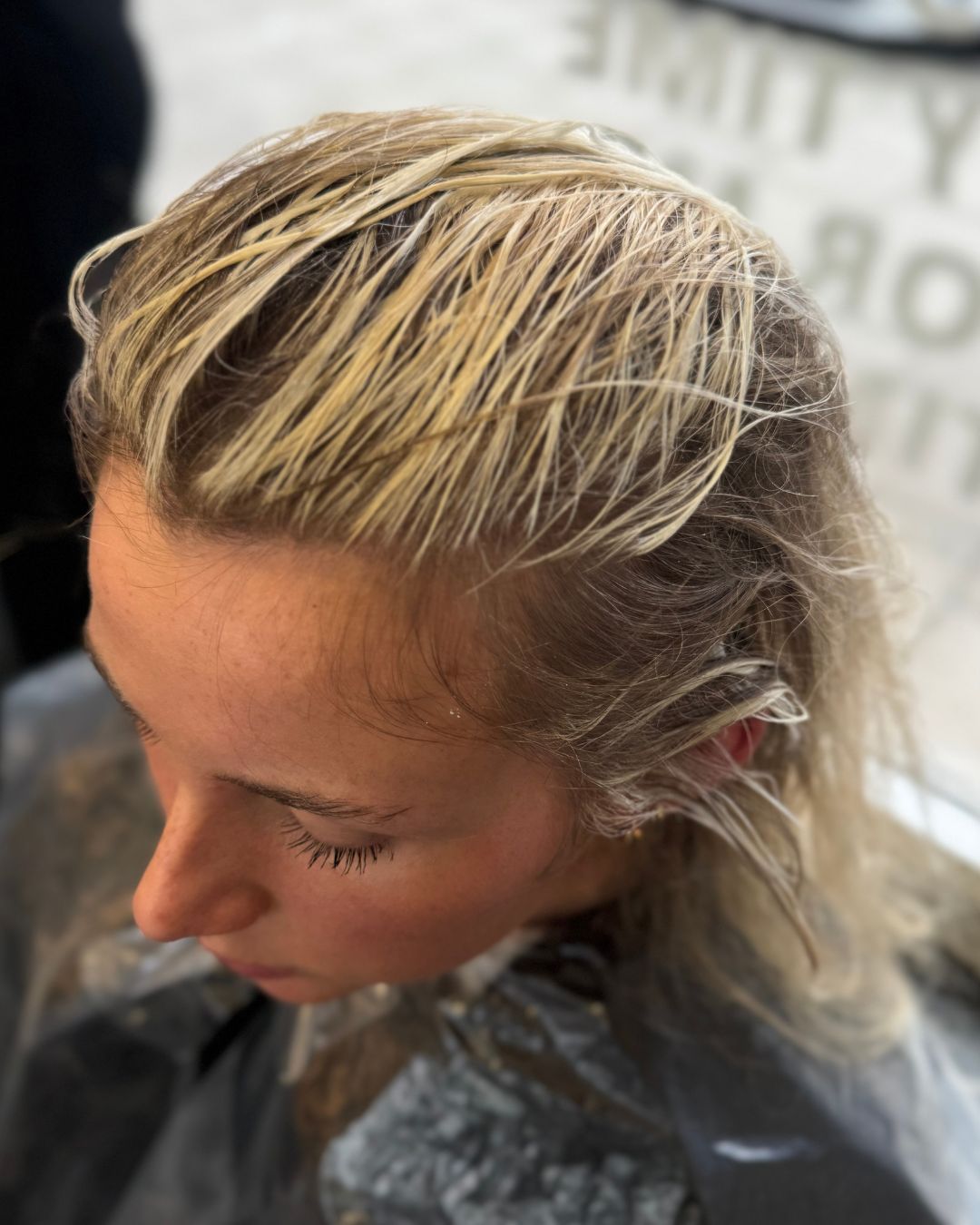
Lilybelle had last been in for colour six months earlier, back in September. Her natural regrowth had come through noticeably darker at the root, creating a visible contrast against her lighter ends. The lengths were in reasonable condition, but the overall effect was heavy and flat. The brightness that had made her hair feel alive was gone.
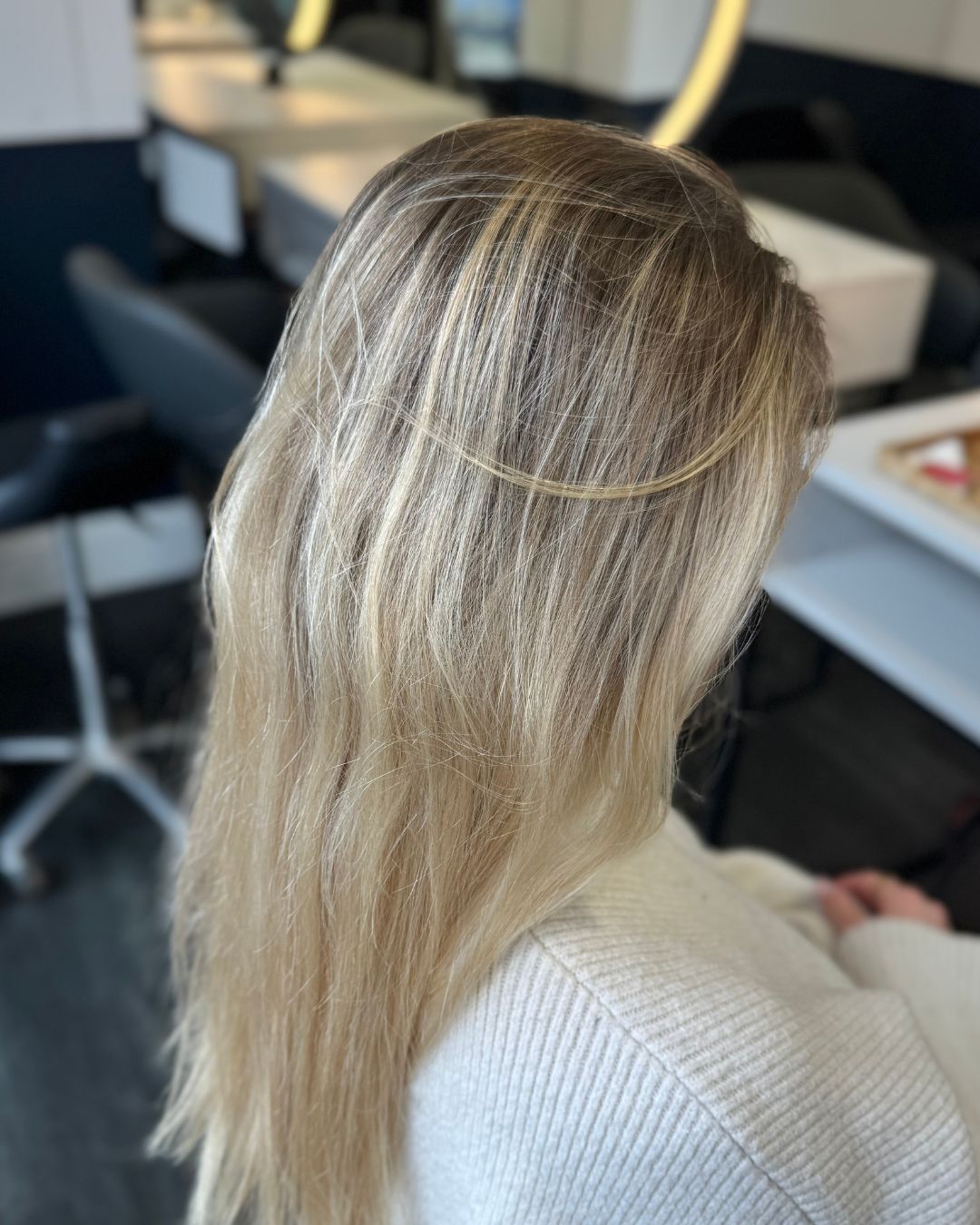
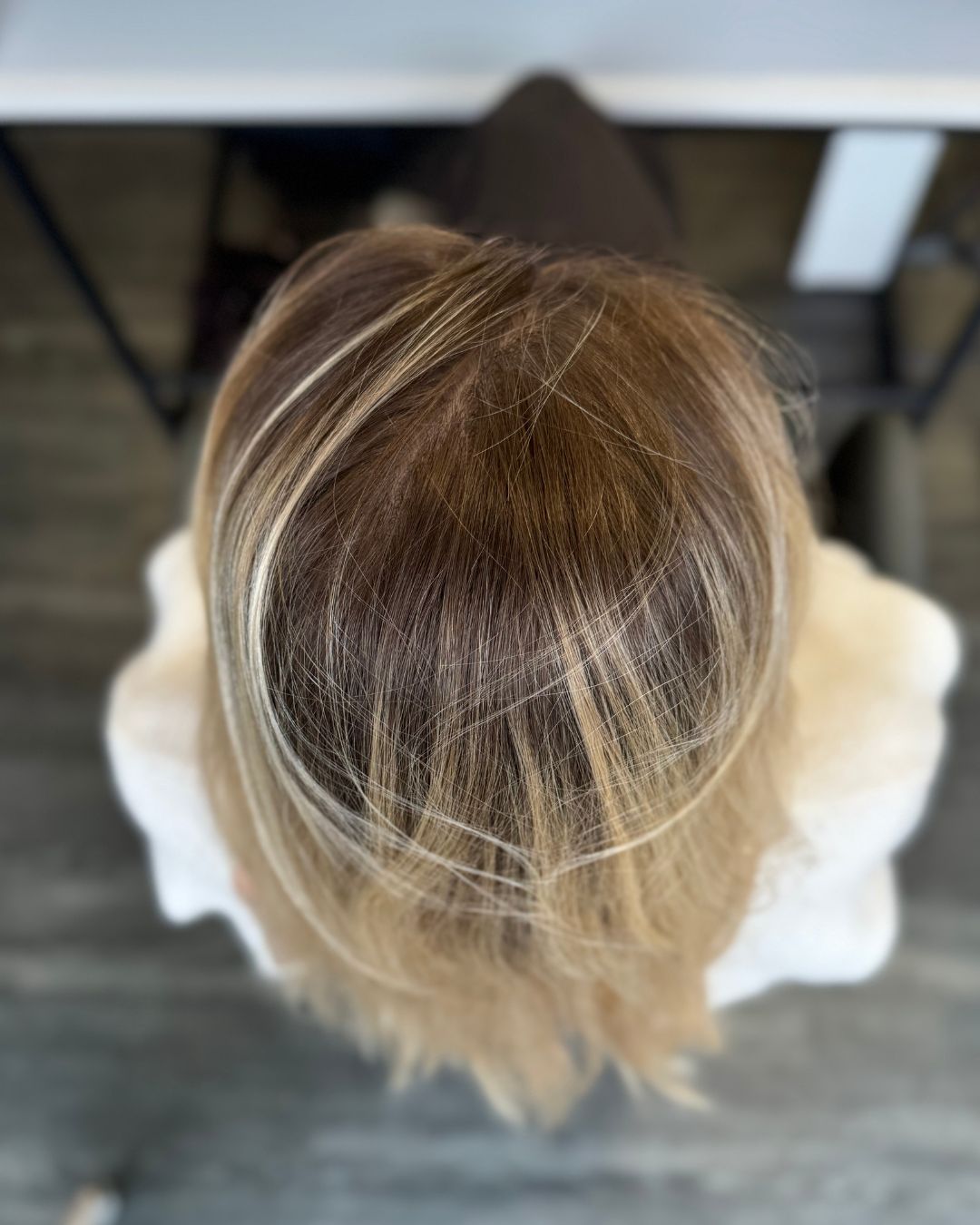
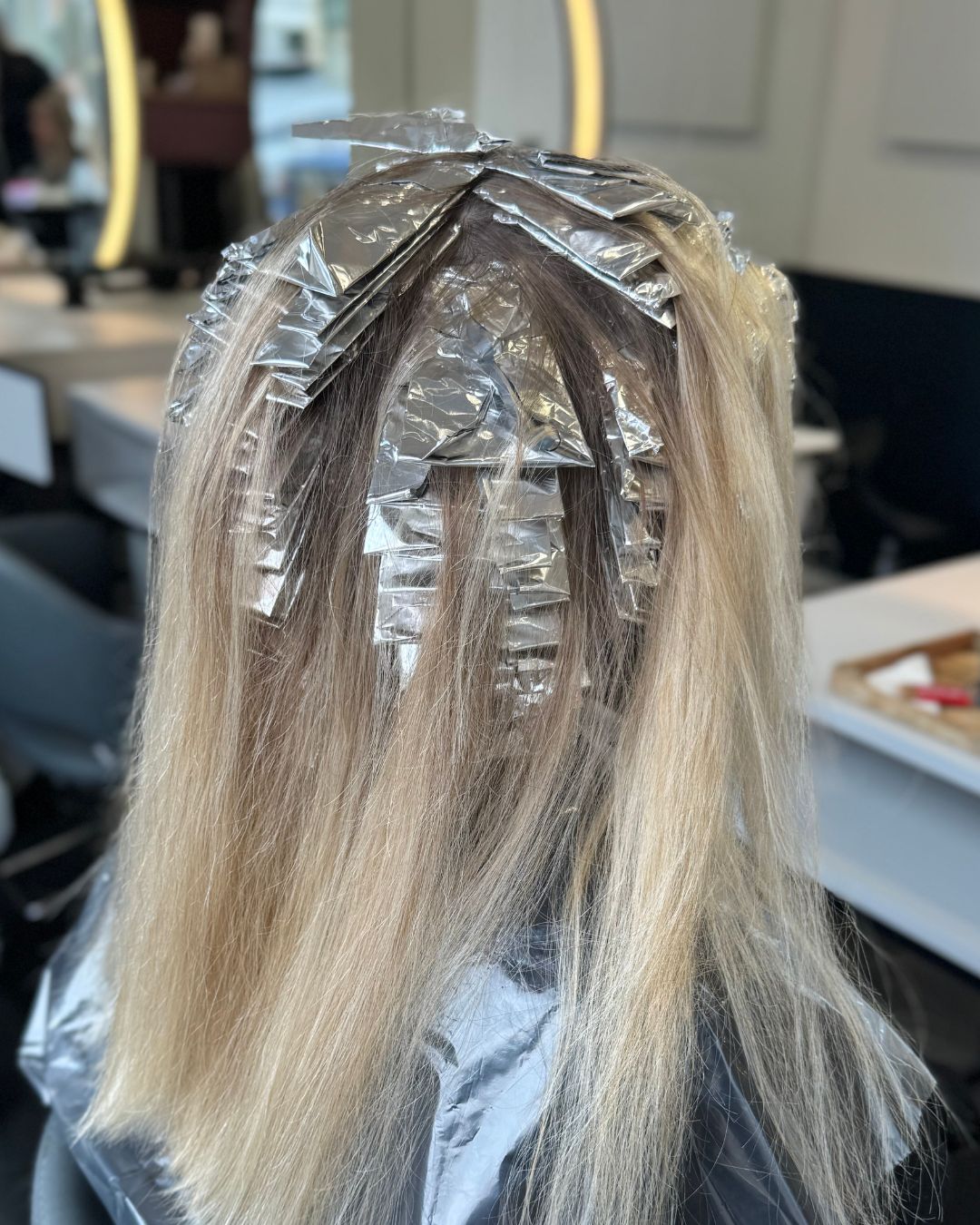
The top down photograph says it most plainly. A wide band of darker natural growth contrasting against the lighter blonde below. Not damaged. Not in bad shape. But flat, heavy and without energy.
What she told us in the consultation
We took Lilybelle through our full consultation before touching a thing. She was clear about what she wanted and equally clear about what she did not want.
What she wanted: Brightness back, especially around the face. A warm, creamy blonde with dimension. Something that looked healthy and luminous. The feeling she had when she left after her September appointment.
What she did not want: Nothing ashy or cool. Nothing too dark. No brassiness. And above all, she wanted the condition of her hair protected throughout.
The inspiration
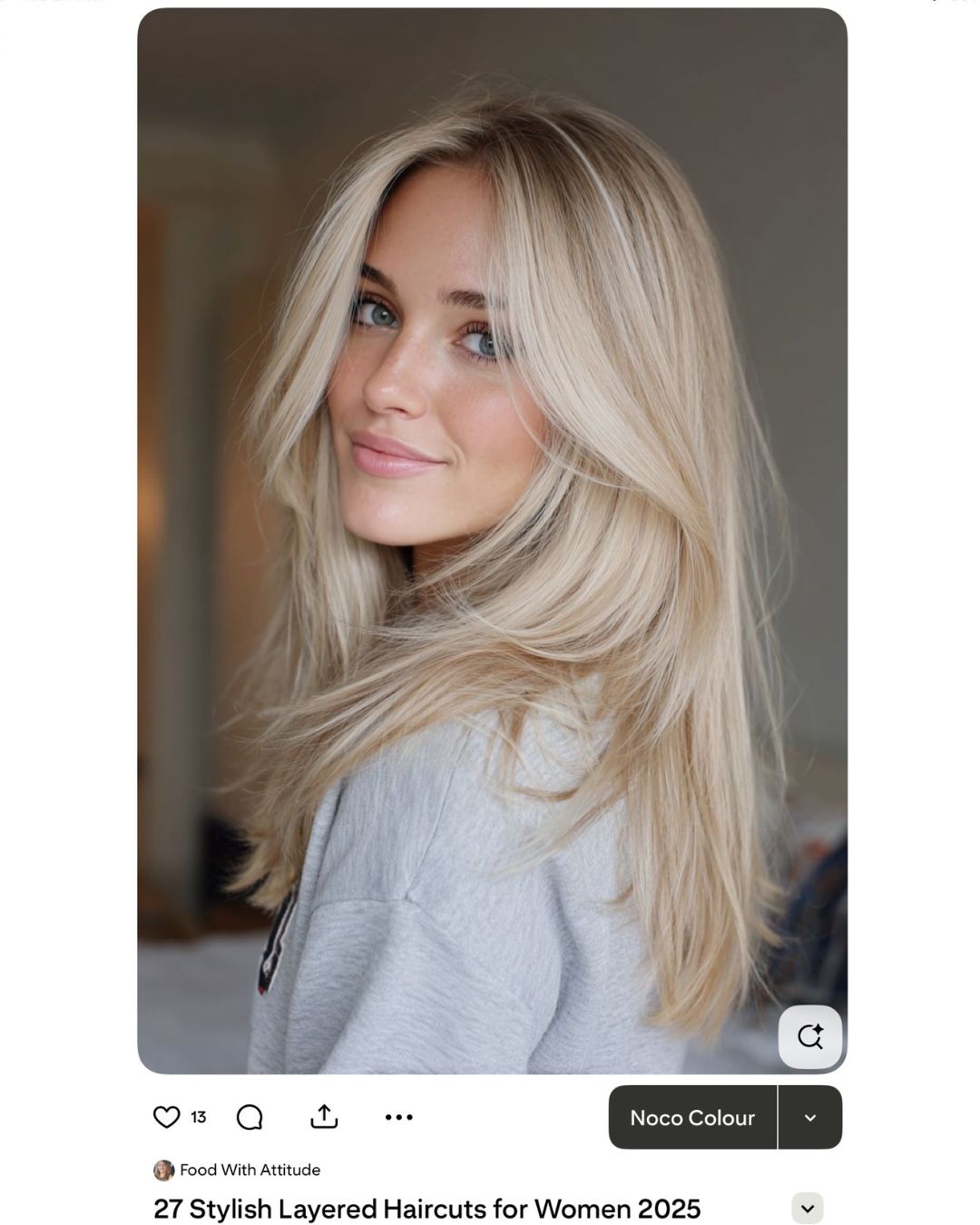
Lilybelle came with reference images showing long, layered blonde hair with soft dimension. Both had the same quality she was drawn to: brightness around the face, warmth through the lengths, and a lived-in quality that felt effortless rather than overdone. That brief guided every decision in the process that followed.
Our approach to blonde highlights in Bristol
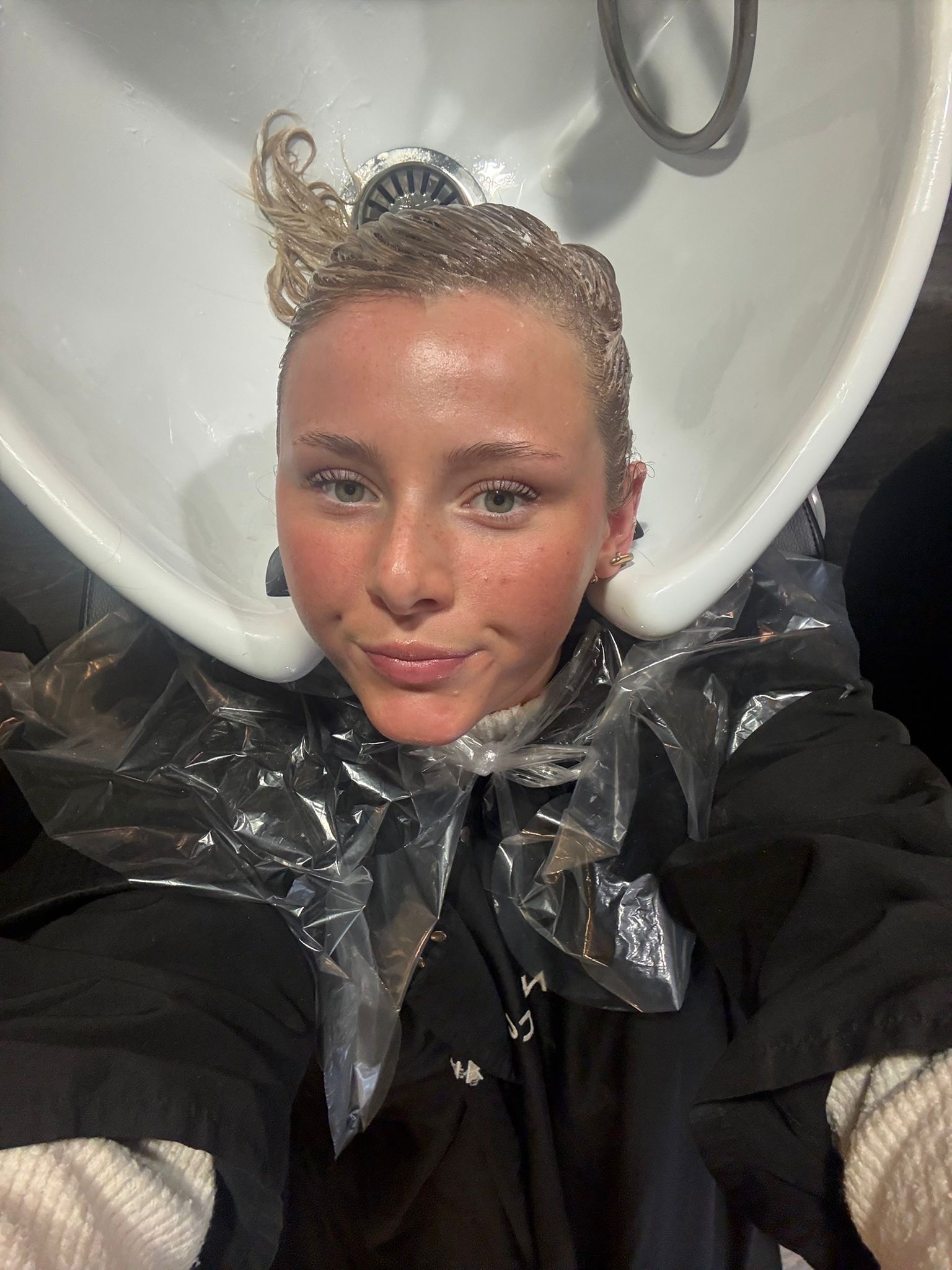
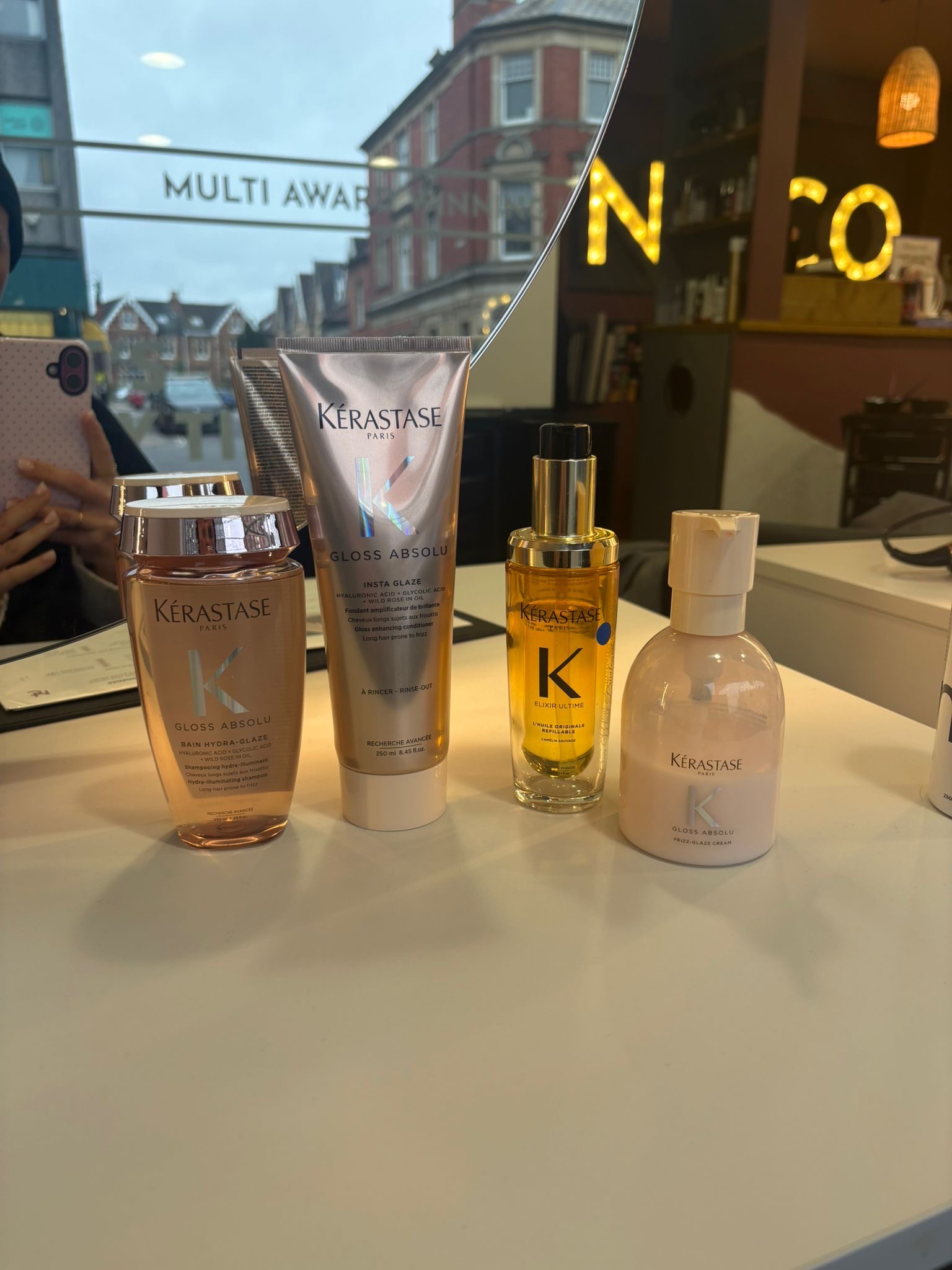
With the brief clear, the plan came together quickly. A full head of highlights to flood the hair with brightness, working particularly around the face. We would then tone the result to land in that warm, creamy blonde territory, and finish with our deluxe treatment package to ensure the condition matched the colour.
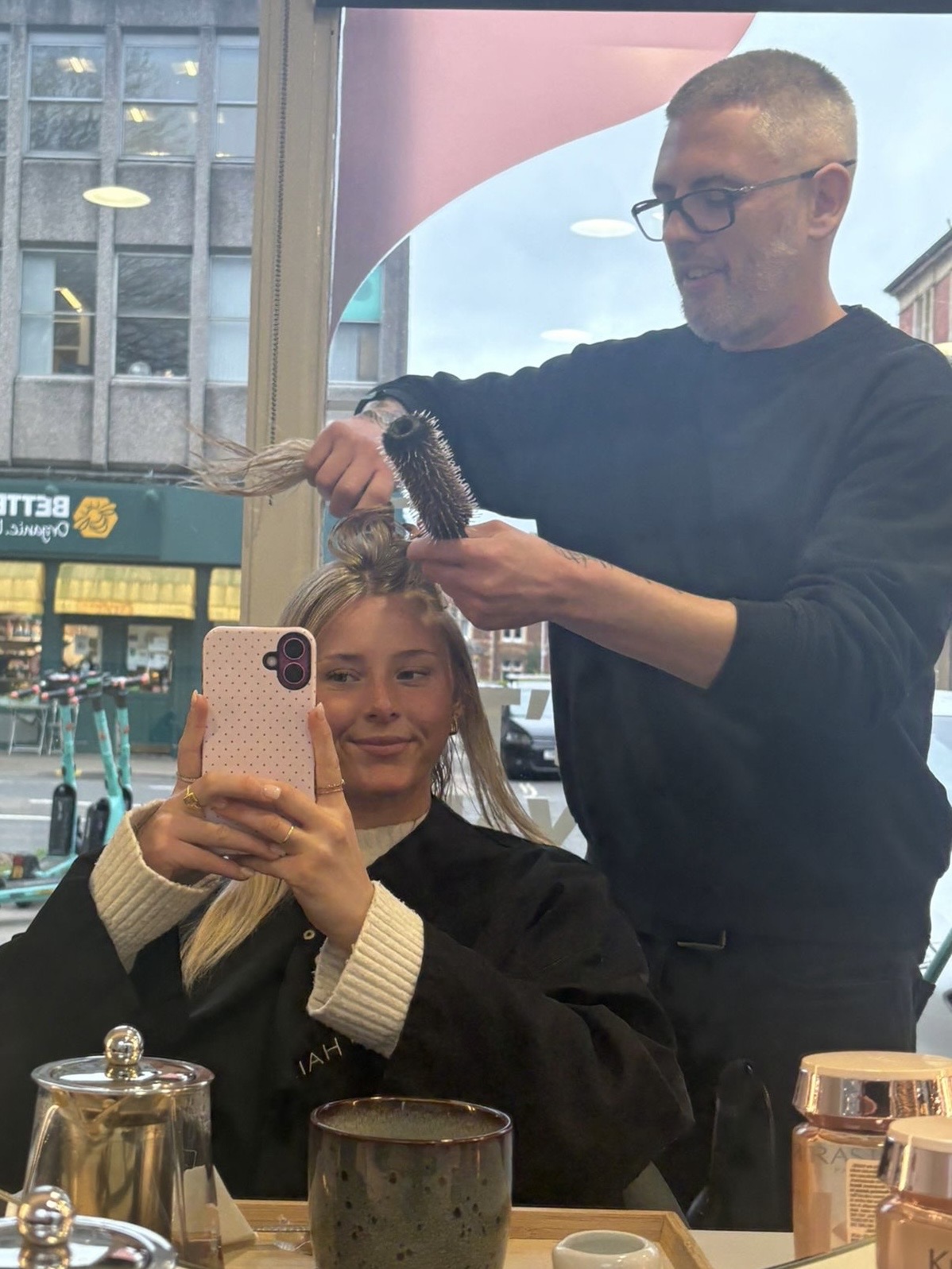
The treatment package
This is where Lilybelle’s result went from good to exceptional. Lightening services put the hair under stress. The way you manage that stress determines not just how the hair looks when the client leaves, but how it behaves for the weeks that follow.
The result
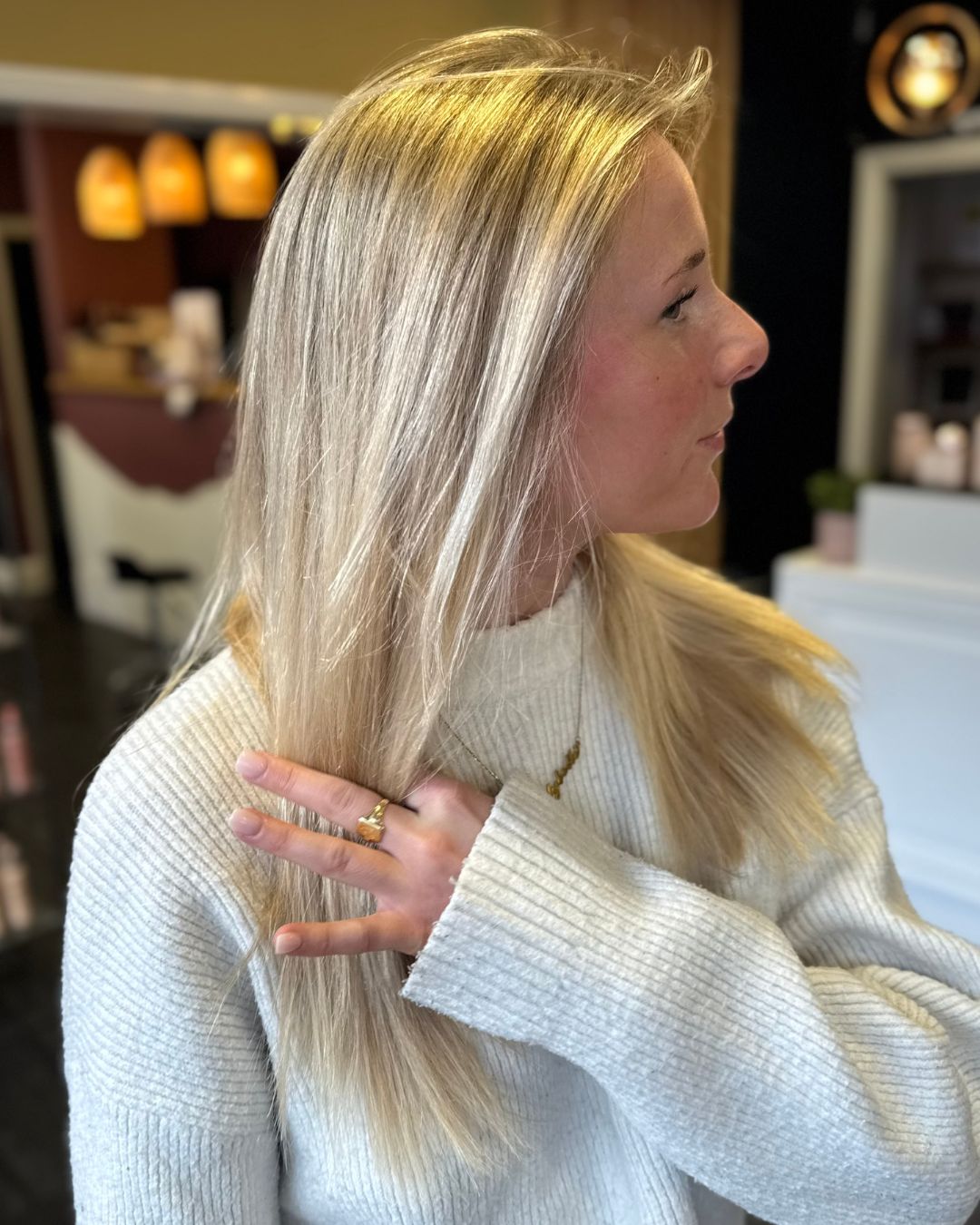
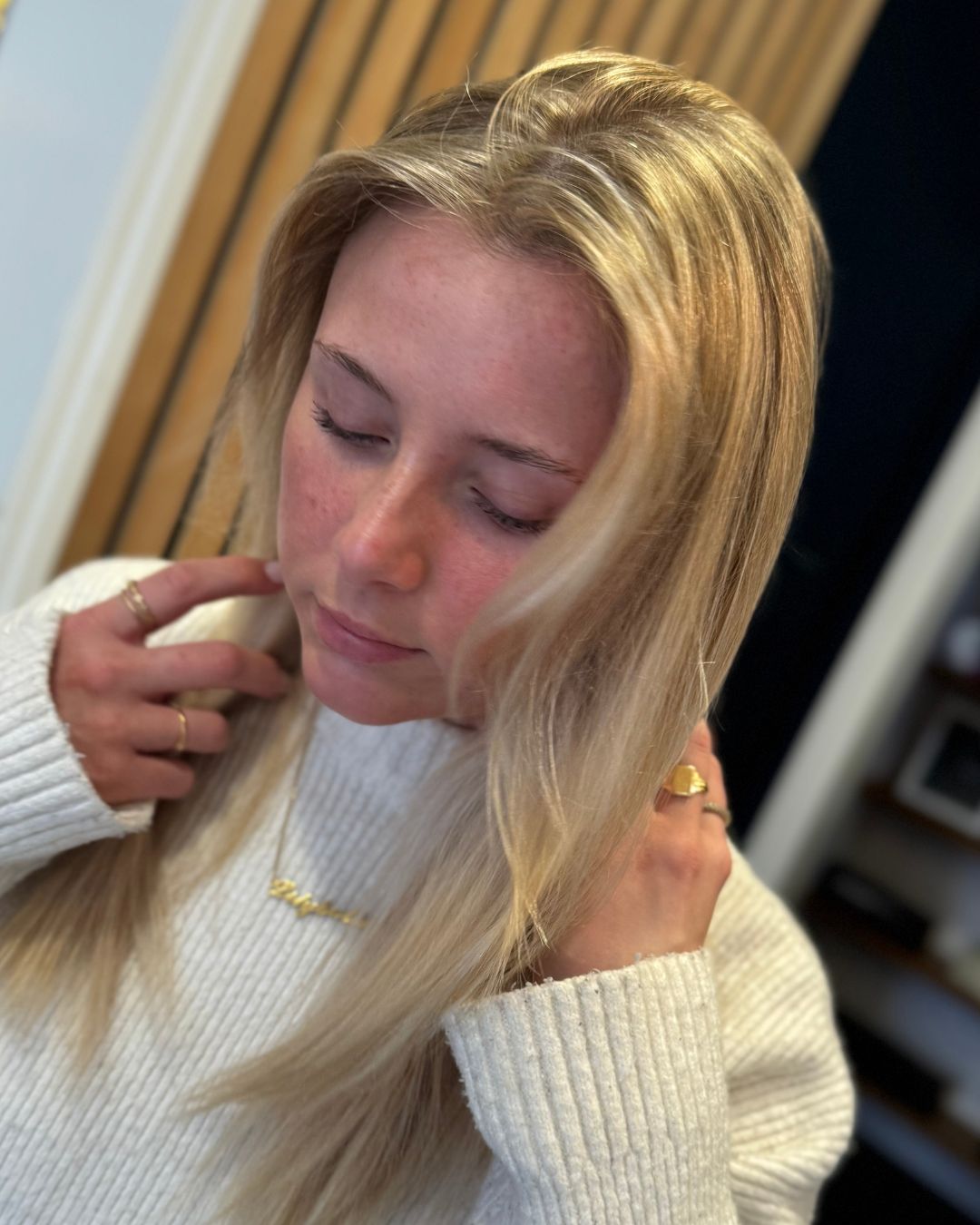
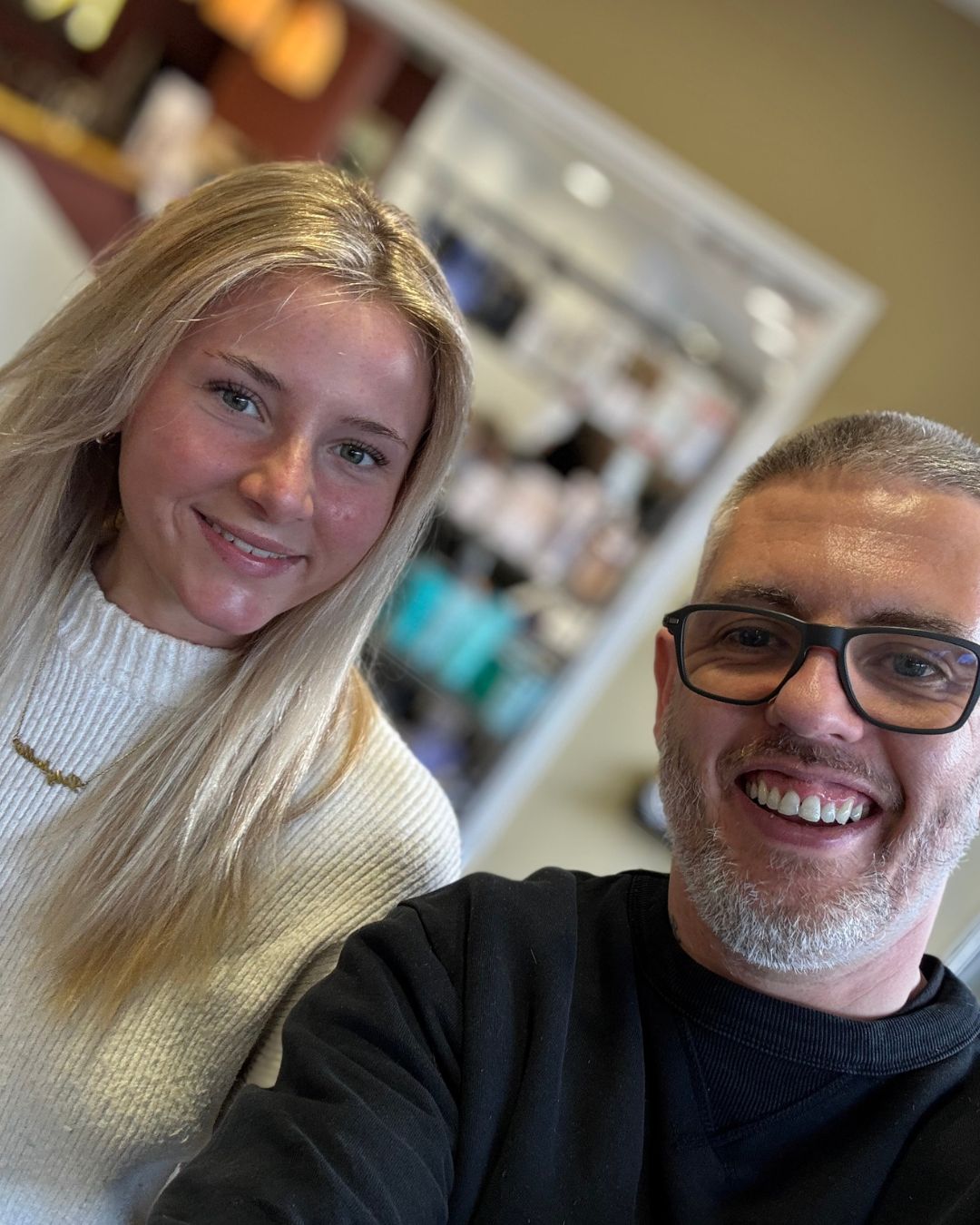
The transformation speaks for itself. Six months of regrowth and a flat, heavy colour replaced with a creamy, luminous blonde that catches the light exactly as she described. The face framing is bright without being stark. The lengths have dimension. The condition is exceptional.
Why the consultation made the difference
What made this result possible was not just the technical skill involved. It was the conversation that happened before any colour was mixed.
At NOCO Hair Bristol, every blonde highlights consultation is recorded and documented. Before we touched Lilybelle’s hair, we had a clear record of exactly what she wanted, what she did not want, how she manages her hair at home, and what result she was expecting to leave with. Her non-negotiables were on record. Her inspiration images were documented.
That documentation does two things. It means the stylist has a complete brief to work from. And it means the client leaves knowing that everything they said was heard and acted on.
Lilybelle’s consultation took just under twenty minutes. The colour and cut took four hours. But those twenty minutes were what made the four hours count.
The investment
We believe in being transparent about pricing. Here is exactly what Lilybelle’s appointment included and what it cost.

Hair does not lie. When something is off in your body or your routine, your hair will often show it first. That is not a reason to panic. It is a signal worth paying attention to.
Someone sits down, runs their fingers through their hair, and says the same thing we hear every week: “It just keeps coming out. In the shower. On my brush. On my pillow. I don’t know what’s going on. Is this just my age?”
Sometimes, yes. But most of the time, no. And that is the important part. Because most of the causes are fixable.
What is actually normal?
Losing between 100 and 150 hairs a day is completely normal. Hair works in cycles: growing, resting, shedding and regrowing. You are always losing hair. You just do not always notice it.
It becomes more concerning when it becomes visible. The drain looks fuller. Your brush fills faster. Your ponytail feels thinner. That is your signal that something has changed.
The real reasons we see in the salon
This is where most people get it wrong. They jump straight to “I’m going bald” or “it’s just age.” In reality, it is usually one of these.
What you should do first
Most people jump too far ahead. Start simple.
Check your shampoo. Is it right for your hair and scalp? Bring conditioner back if you have dropped it. Reduce heat slightly, even one or two days a week. Look back 3 to 4 months. What actually happened in your life?
Hair is rarely random. There is usually a pattern.
When to take it further
If it is ongoing or feels excessive, go deeper. Speak to your GP if you notice ongoing shedding beyond 3 to 4 months, fatigue, changes in skin or nails, or weight shifts. Simple blood tests can flag issues such as iron levels, thyroid function and vitamin D deficiency.
From a salon perspective, this is where a proper consultation matters. You need to know whether it is shedding, breakage or thinning. Three different problems. Three different solutions.
The way we see it
Hair does not lie. When something is off in your body or your routine, your hair will often show it first. That is not a reason to panic. It is a signal. Pay attention to it.
At NOCO, we do not guess. We diagnose first, then design. Because better hair does not come from doing more. It comes from understanding what is actually going on.

Whether your hair can take more bleach depends on four things: the result you want, the technique used to get you there, your previous colour history, and how strong your hair already is. There is no single rule that works for everyone.
This is one of the most common questions we hear in the salon. And it is the right question to ask. Because bleach does not fail. Hair fails when it is pushed too far. The real question is not whether it can go lighter. It is whether it can stay healthy if it does.
What bleach actually does to your hair
Bleach opens the outer layer of the hair shaft. Once open, it moves inside and removes pigment to make the hair lighter. At the same time, it removes structural strength. Every bleach service carries some level of risk, which is why the condition of your hair before we start matters so much.
A gentle lift to add warmth is very different from removing colour and going from dark to light. The approach, the speed, and the level of risk all change depending on the result you are trying to achieve.
Signs your hair may not be ready
These are not automatic red lights. They are signals worth checking properly before we proceed.
In many cases, hair that shows warning signs can still be worked on safely. It just needs the right approach. This is not about stopping. It is about doing it well.
Why a strand test matters
A strand test means taking a small section of hair and applying colour or bleach to it before working on the whole head. It shows us how fast the hair lifts, how evenly it lifts, how much strength it keeps, and when it is safest to stop.
Alongside this we check elasticity. We gently stretch a strand of hair between two fingers. Hair that stretches and returns generally has good strength. Immediate snapping may indicate dryness or brittleness. Stretching too far without returning usually means the hair needs protein support before we proceed.
These tests are most important when bleaching over existing bleach, or when your hair has been through multiple colour services. That is where damage can build quickly if hair is pushed beyond what it can handle.
How timing affects the decision
Timing matters, but it is not the same for everyone. It depends on hair length, how much new growth there is, the type of colour being used, and whether bleach would overlap hair that is already light.
In most cases, previously lightened ends do not need to be bleached again. If they are already light and healthy, we protect them rather than overlapping. Pushing too soon does not save time. It costs hair.
Can products fix hair enough to bleach again?
Modern bond builders and treatments have come a long way. They can reduce breakage, support strength during bleaching, and improve how hair feels and behaves. But there is a limit to what they can do.
Products cannot replace hair that has already been lost, and severely compromised hair cannot be fully repaired by a treatment alone. When hair is healthy enough, bond builders can make bleaching safer and more comfortable. When it is not, the safest option is to pause and rebuild first. Knowing the difference comes from proper assessment, not guesswork.
Foils versus open air techniques
Technique matters as much as timing. When hair is wrapped in foil, heat builds and the lift is stronger. The risk is higher. When bleach is applied in open air, the process is slower, the lift is gentler, and the hair has more protection.
In some cases, lifting low and slow is the safest option. In others, a stronger lift can be used carefully with proper protection. It depends on the hair, not just the colour goal. There is always some level of risk when colouring hair. The role of a professional is to manage that risk properly, not to eliminate the conversation about it.
Frequently asked questions
Can my hair take more bleach?
Sometimes yes, sometimes no. It depends on the strength of your hair, previous colour history, and how the bleach would be applied. A professional check is the safest way to decide.
Is bleaching over already bleached hair risky?
It can be. Overlapping bleach is where most damage happens. In many cases, previously lightened ends do not need to be bleached again and are protected instead.
Do foils make bleaching stronger?
Yes. Foils increase heat and speed up lift. Open air techniques are slower and gentler. The safest option depends on the hair and the desired result.
Can products make my hair strong enough to bleach again?
Products can help support strength and reduce breakage, but they cannot replace hair that has already been lost or fully repair severely compromised hair.
How long should I wait between bleaching appointments?
Around six weeks often works well for root work. Longer gaps can still be managed but usually require more time and care. There is no single rule for everyone.
Will bleaching always damage my hair?
There is always some level of risk when colouring hair. The goal is not to remove risk completely, but to manage it properly through testing, planning and technique.