February 2026
Noel Halligan
NOCO Hair, Bristol
Hair Health
Hair Growth
Hair Health · Bristol · NOCO Hair
How Long Will It Take for My Hair to Grow Back?
One of the most common questions we hear. The honest answer depends on why it changed in the first place.
Hair Growth
Hair Loss
Hair Health
How long it takes for hair to grow back depends on why it changed in the first place. After hair loss, breakage, a big cut, or a fringe you have grown out of, the question is almost always the same: will it come back, and how long will it take?
Most people asking this question are going to get a positive answer. Hair is remarkably resilient. Understanding how it grows helps you understand what to expect and why patience is almost always the right approach.
How hair actually grows
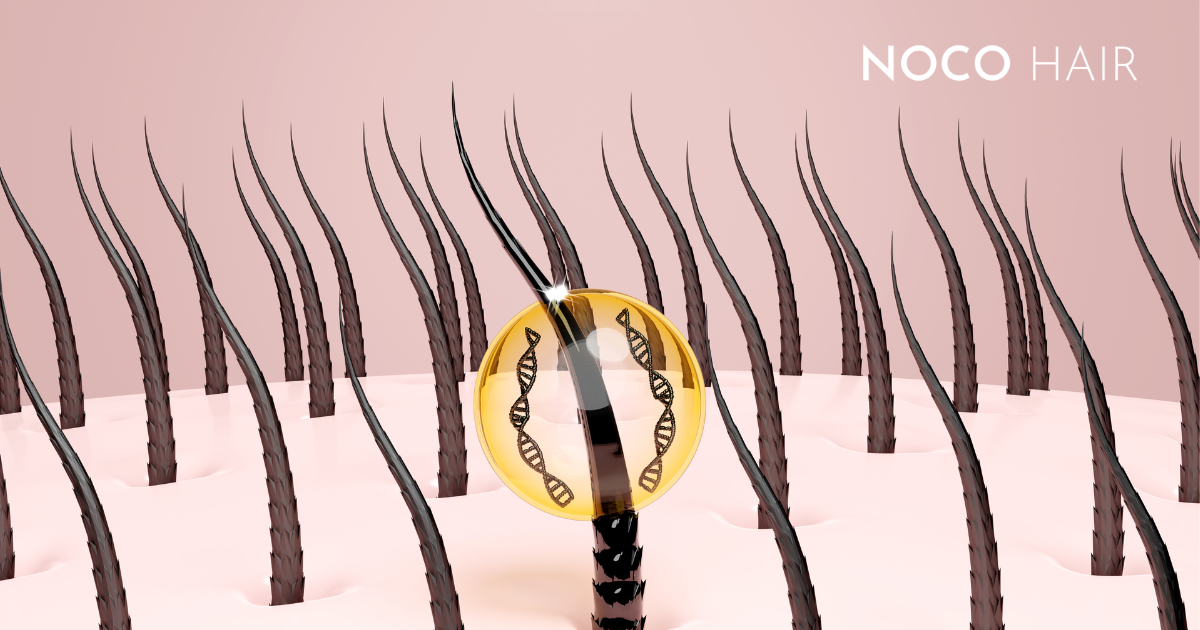
Each hair on your head goes through its own growth cycle. The active growth phase, called the anagen phase, lasts anywhere from two to seven years depending on your genetics. During this time the hair grows roughly half an inch a month, or around six inches a year.
If your growth phase runs closer to seven years, your hair has the potential to grow very long before it naturally sheds and regrows. A shorter growth phase of around two years means your hair may reach a natural stopping point, often around the jawline or shoulders, even when it is perfectly healthy. Neither is better or worse. It is simply how your hair is built.
A useful way to think about it
The average head has 100,000 to 150,000 hairs, each growing around 0.2cm a day. Per strand that sounds slow, but across the whole head it adds up to over 36 metres of total hair growth in a single day. It is constant, just not immediately visible.
Why it feels slow at first
Hair grows from the root, not the ends. This means in the early weeks of regrowth you will not see much visible change, even though growth is happening. New hair has to travel a certain distance before it becomes noticeable at the surface.
People with fringes often notice hair growing back faster because it reaches their eyes. Length growth is harder to perceive because there is no equivalent reference point. The hair is growing. You simply cannot see it yet.
What affects how quickly hair grows back
The speed and quality of regrowth depends largely on what caused the change in the first place.
Common causes and what to expect
Breakage. Hair that has snapped from heat damage, colour or tension is not lost from the follicle. The follicle is still active and producing hair. Regrowth is usually straightforward once the cause is addressed.
Stress-related shedding. Telogen effluvium, the most common cause of sudden increased shedding, is temporary. Hair typically begins recovering three to six months after the trigger passes.
Postpartum shedding. Almost always recovers fully within six to twelve months. The shedding is caused by hormonal shifts after birth, not permanent follicle damage.
Illness or medication. Hair often recovers well once health stabilises, though the timeline varies depending on the condition and how long it was present.
A significant haircut. Simply a matter of time and the length of your individual growth phase. Around six inches a year is the average, though some people grow faster or slower.
What helps while hair is growing back
You cannot dramatically speed up hair growth. What you can do is create the best possible conditions for the growth that is already happening.
What actually makes a difference
Scalp health. A healthy, clean scalp supports stronger regrowth. Remove product buildup, avoid harsh shampoos and consider a targeted scalp treatment if needed.
Reducing tension and heat. Less daily stress on the hair means less breakage, which means visible length is retained better over time.
Nutrition. Protein, iron, zinc and vitamin D all support healthy hair growth. If you have been through a period of significant dietary change, addressing that will help.
Regular trims. This one surprises people, but keeping the shape tidy every six to eight weeks prevents the ends from fraying and weighing the hair down. Growth looks faster when the hair does not feel tired.
“Hair growth is slow, but it is steady. If the cause is temporary, hair almost always recovers. Knowing what is happening is the key to getting the best out of what you have.”
Noel Halligan · NOCO Hair Bristol
When hair may not grow back fully
For most people, hair does recover well. There are some situations where the picture is more complex. Genetic thinning, certain hormonal conditions and some longer-term health issues can affect follicle activity over time. Even in these cases, early assessment and the right support can slow the process significantly and improve the quality of what remains.
The most important thing in any case is understanding what is actually happening rather than guessing. A professional can usually identify whether you are dealing with temporary shedding, breakage or something that needs a more structured approach.
N
Written by
Noel Halligan
Co-founder and Senior Stylist · NOCO Hair Bristol
Noel Halligan is a Bristol-based hairstylist and salon educator with over 20 years of experience in colour and cutting. As co-founder of NOCO Hair, he has developed a consultation led approach to hairdressing that prioritises diagnosis before design. He works with clients on complex colour transformations and trains stylists through the NOCO Academy.
Not sure what is going on with your hair?
Come in for a proper consultation. We will assess your hair and scalp, tell you what we see and give you a clear plan based on what is actually happening.
Book a Consultation
March 2026
Noel Halligan
NOCO Hair, Bristol
Hair Health
Bristol
Hair Health · Bristol · NOCO Hair
Is Bristol’s Water Causing Your Hair Loss?
We hear this from Bristol clients regularly. The water is not entirely innocent. But it is rarely the whole story either.
Hard Water
Hair Loss
Scalp Health
Is Bristol’s water causing hair loss? It is one of the questions we hear most from clients who have noticed a change since moving to the city, or who have been here a while and cannot explain why their hair feels different. The water is worth understanding. But it is rarely the only thing going on.
Bristol sits in a moderately hard water area. That means the water contains a higher concentration of dissolved minerals, primarily calcium and magnesium, than you would find in a soft water region. Over time, this has a real and measurable effect on hair and scalp.
What hard water actually does to hair
Hard water does not cause hair loss directly. What it does is create conditions that make hair more prone to breakage, dryness and scalp irritation over time. When those things build up, they can look and feel very much like hair loss.
The effects of hard water on hair and scalp
Mineral buildup on the hair shaft. Calcium deposits coat the outside of the hair over time, making it feel rough, dull and harder to manage. Products absorb less effectively and colour fades faster.
Scalp dryness and irritation. Hard water disrupts the natural moisture balance of the scalp, leading to dryness, flaking and sensitivity. An irritated scalp is not an optimal environment for healthy hair growth.
Increased breakage. Hair coated in mineral residue becomes more brittle and prone to snapping. This is frequently mistaken for hair loss because the hair appears to be thinning, but the follicle is still active.
Colour and treatment results suffer. Hard water interferes with how colour and conditioning treatments bond to the hair. Results look less vibrant and fade more quickly between appointments.
The distinction that matters
Hard water is more likely to cause breakage and scalp disruption than true hair loss. Breakage means the hair shaft is snapping. Hair loss means the follicle is shedding. They look similar but need completely different solutions.
Why Bristol comes up specifically
Bristol draws its water from a combination of sources including reservoirs in the Mendips and the River Severn. The hardness level varies across the city but sits broadly in the moderately hard range. It is not as extreme as parts of London or the South East, but it is noticeably harder than soft water areas in Wales or the North West.
People who move to Bristol from a soft water area often notice the difference quickly. Hair feels drier, products lather less, and the scalp can feel tighter or more reactive than before. These are real changes caused by water chemistry, not imagination.
Watch: Noel Halligan on Bristol’s water and hair loss
After being contacted by the Sunday Times about potential hair loss linked to Bristol’s water, I sat down to dig into what is really going on. From mineral buildup to scalp health, this conversation covers the facts behind the question.
Watch the full conversation
You are currently viewing a placeholder content from YouTube. To access the actual content, click the button below. Please note that doing so will share data with third-party providers.
More Information
Noel Halligan, Co-founder of NOCO Hair Bristol, discussing the real link between Bristol’s water and hair health.
When water is not the only cause
Hard water is one factor. In the salon we rarely see hair changes that have a single cause. Clients concerned about thinning or increased shedding in Bristol are usually dealing with a combination of things.
Other factors we look at alongside water quality
Stress. One of the most common triggers for increased shedding. Physical or emotional stress pushes hair into a shedding phase that can appear two to four months later.
Hormonal changes. Postpartum, perimenopause and menopause all significantly affect hair density and scalp condition.
Nutritional gaps. Low iron, vitamin D or protein affect hair growth and quality. Hard water does not cause these, but they are often present alongside water-related concerns.
Product buildup. Hard water accelerates product buildup. Residue accumulates faster, blocking follicles and disrupting the scalp environment further.
Heat and styling damage. Hard water weakens the hair surface over time. Regular heat styling on top of that compounds the effect on condition significantly.
What you can do about it
The effects of hard water on hair are manageable. None of the practical solutions are complicated or expensive.
Practical steps that make a real difference
Use a chelating or clarifying shampoo once a week. Chelating shampoos are specifically designed to remove mineral deposits from the hair shaft. A weekly use alongside your regular shampoo makes a noticeable difference over time.
Prioritise scalp care. A scalp serum or targeted treatment used regularly keeps the follicle environment healthier, particularly in a hard water area.
Use a good conditioner every wash. Hard water strips moisture from the hair more aggressively. A quality conditioner helps restore what the water takes out.
Consider a shower filter. Shower head filters that reduce mineral content are widely available and can reduce the daily load on hair and scalp noticeably.
Book a scalp assessment. If your hair has been noticeably different and simple routine changes have not helped, a proper scalp assessment gives you a clear picture of what is actually happening before you spend money guessing.
“Hard water is a real factor for Bristol clients, but it is rarely the only one. Understanding the full picture is always where we start.”
Noel Halligan · NOCO Hair Bristol
N
Written by
Noel Halligan
Co-founder and Senior Stylist · NOCO Hair Bristol
Noel Halligan is a Bristol-based hairstylist and salon educator with over 20 years of experience in colour and cutting. As co-founder of NOCO Hair, he has developed a consultation led approach to hairdressing that prioritises diagnosis before design. He works with clients on complex colour transformations and trains stylists through the NOCO Academy.
Concerned about your hair in Bristol?
Come in for a consultation. We will assess your scalp and hair condition, look at the full picture and give you a clear, honest plan.
Book a Consultation
May 2022
Noel Halligan
NOCO Hair, Bristol
Colour
Colour Correction
Colour Advice · Bristol · NOCO Hair
How to Fix a Hair Dye Disaster
No hair colour disaster is completely unfixable in the right hands. Here is what to do depending on what went wrong.
Colour Correction
Brassiness
Hair Damage
Whether you trusted your hair to the wrong stylist or an attempt at home colouring went sideways, a dye mishap can feel like a nightmare. But no hair colour disaster is completely unfixable in the right hands. The first step is understanding what actually went wrong.
Colouring hair is a more delicate process than the box dye adverts suggest, particularly when bleach is involved. Here is what we see most often and what can be done about each one.
Brassiness and bad blonde
Blonde is one of the most popular colour results and one of the easiest to get wrong. Too much lift in one direction can leave you with green-grey ashy tones, orange brassiness or a yellow that reads more Barbie than beachy.
Quick fixes for brassiness
Too warm or brassy. A blue or purple toning shampoo used once or twice a week will neutralise yellow and orange tones. These work on the colour wheel principle — cool cancels warm. A purple toning mask used for ten minutes gives a stronger result.
Gone too ashy or grey. Warming toner in yellow or orange tones corrects over-cooled blonde. This is best done in a salon where the exact tone can be controlled.
Stubborn orange highlights. Some orange tones, particularly from overlapping bleach, cannot be toned out. In these cases the hair may need to be re-bleached and started again properly. A consultation will confirm which route is needed.
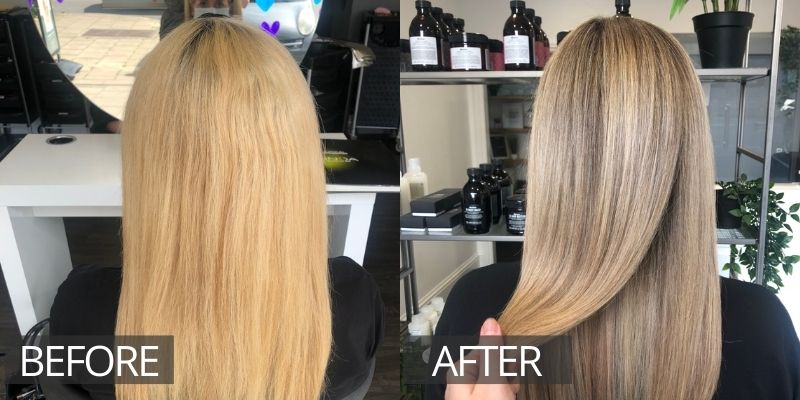
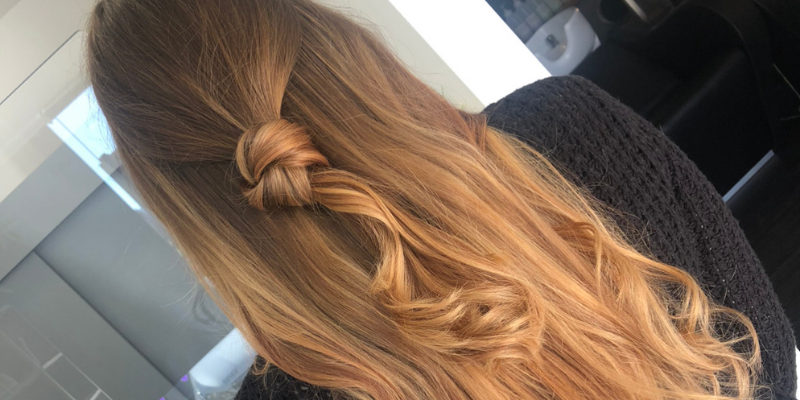
Colour correction work at NOCO Hair Bristol.
Hot roots
Hot roots appear when the hair at the root develops differently from the rest, creating a two-tone effect that looks unintentional. It happens most often when previously processed hair reacts differently to fresh colour, or when the heat from the scalp causes the dye at the root to develop faster and lift higher than the lengths.
A small amount of anti-brass or cool toner applied to the roots can help at home. In a salon, a colourist can correct hot roots using a slightly deeper shade at the root to balance the overall result. For future colour, applying the dye to roots last, after coating the lengths, reduces the risk of this happening again.
The cause most people miss
Body heat at the scalp speeds up colour development. A shade that looks right on the lengths can lift two levels lighter at the root in the same development time. This is why root application timing matters so much and why guessing at home often goes wrong.
Colour that has gone too dark or intense
Left colour on too long? The first response is to wash immediately, several times if needed. A clarifying shampoo strips colour faster than a regular shampoo. Follow immediately with a deep conditioning treatment as clarifying shampoo is harsh on the hair structure.
From there, a stylist can advise the best route. In some cases the dye can be removed or lifted. In others, encouraging it to fade naturally over a few weeks while protecting the hair is the better option. Highlights or balayage can also be used to break up the intensity and lighten the overall effect without a full removal process.
Patchy or uneven coverage
Patchy colour coverage is one of the most common results of home dye jobs and can also happen with inexperienced stylists. The causes range from incorrectly mixed product to uneven application, damaged hair that absorbs colour inconsistently, or missed sections.
“My hair was in a bit of a poor state due to box dyes during lockdown and a patchy colour job from another salon. I definitely felt that Marika cared and took the time to go through exactly what I wanted and what she felt would be best for my hair going forward. It looks so much healthier.”
Sophie Wills · NOCO Hair Bristol
A professional can identify exactly what caused the patchiness and correct it using a combination of targeted re-colouring, toner, gloss treatments or condition work depending on the root cause. Colour often needs more than one pass to build depth evenly, in the same way that painting a wall benefits from an undercoat before the finish coat.
Stripey or chunky highlights
Bold, visible streaks rather than blended highlights usually happen when sections placed in foil are too thick. The result lacks the dimension and movement that makes highlights look natural.
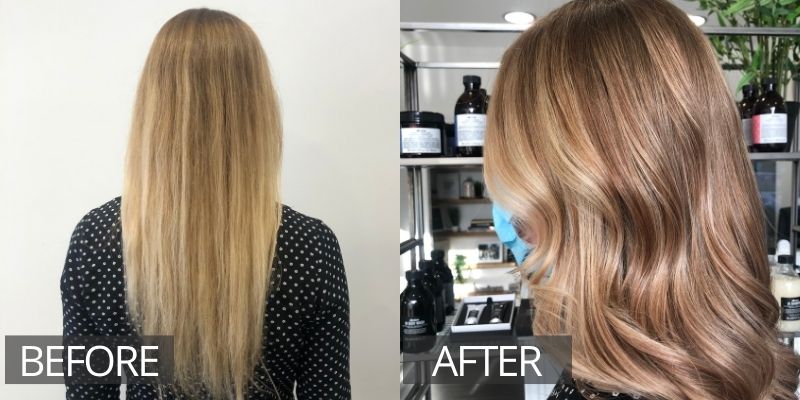
Balayage used to soften and blend overly chunky highlight work at NOCO Hair Bristol.
The two most effective salon fixes are blending the base colour back through to reduce the contrast between highlighted and unhighlighted sections, or using balayage to hand-paint colour in a way that disguises the foil sections and creates a more gradual, natural result.
“Colour correction is one of the most skilled things we do. The consultation is where we work out what actually happened before we touch anything.”
Noel Halligan · NOCO Hair Bristol
Hair dye on skin
Staining around the hairline, neck and ears is extremely common. At the salon we use a professional stain remover. At home, milk on cotton wool works surprisingly well. Regular soap and water clears most fresh stains. For anything more stubborn, baby oil, a gentle body scrub or a small amount of rubbing alcohol applied lightly without scrubbing will usually clear it.
Prevention is more effective than removal. Always use gloves when colouring at home, wipe any drips immediately before they set, and apply a barrier of moisturiser or Vaseline around the hairline before you start.
Damaged hair after colouring
Bleach and permanent dyes work by lifting the outer protective layer of the hair shaft. This is necessary for the colour to penetrate, but it leaves the hair more vulnerable to breakage, frizz, dryness and heat damage until that outer layer recovers.
Managing colour damage
Minor damage. Focus on consistent conditioning. Use a bond-building treatment like Olaplex or a Kérastase masque regularly. Reduce heat. Avoid further chemical processing until the hair has recovered.
Significant damage. A salon assessment will identify the extent of the damage and the best treatment plan. In serious cases a shorter haircut is recommended to remove the most compromised lengths and allow healthier hair to grow through.
Preventing future damage. A patch test and strand test before any colour service, a proper consultation that assesses hair condition before anything begins, and working with a colourist who diagnoses before designing are the most effective protections.
“I would like to thank Corey for such amazing work today. After five hours sorting out and correcting my colour I feel a million dollars. It is truly beyond my expectations.”
Gail Taylor · NOCO Hair Bristol
N
Written by
Noel Halligan
Co-founder and Senior Stylist · NOCO Hair Bristol
Noel Halligan is a Bristol-based hairstylist and salon educator with over 20 years of experience in colour and cutting. As co-founder of NOCO Hair, he has developed a consultation led approach to hairdressing that prioritises diagnosis before design. He works with clients on complex colour transformations and trains stylists through the NOCO Academy.
Got a colour situation that needs fixing?
Come in for a colour consultation. We will assess what happened, explain the options and give you a clear plan for getting your colour right.
Book a Colour Consultation
May 2024
Noel Halligan
NOCO Hair, Bristol
Wellbeing
The NOCO Experience
The NOCO Experience · Bristol · NOCO Hair
The Benefits of a Head Massage
Every NOCO visit includes a scalp massage. Not just because it feels good. The science behind it is genuinely interesting.
Scalp Health
Wellbeing
Hair Growth
Every visit to NOCO includes a scalp massage as standard. We do it because it feels good, yes. But the reasons go deeper than that. Head massages have a genuine and well-documented effect on physical and mental wellbeing that most people do not fully appreciate.
The history of head massage runs through European cave paintings, ancient Chinese texts and traditional Indian medicine. People have always understood intuitively that this kind of touch does something. Modern science has spent the last few decades catching up and confirming why.
What a head massage actually does
The real benefits
Supports hair growth. Several scientific studies from Japan and the US have indicated that regular scalp massage can increase hair thickness over time. The mechanism is thought to involve increased blood circulation to the scalp and stimulation of the dermal papilla cells, which regulate hair nutrition and growth. More research is ongoing, but the early results are encouraging.
Lowers blood pressure. Moving into a relaxed state reduces heart rate and eases muscle tension, both of which contribute to lower blood pressure. The pressure from a massage also pushes blood through congested areas, allowing fresh, oxygen-rich blood to flow in.
Balances the nervous system. Massage has been shown to activate the parasympathetic nervous system, which is the body’s relaxation response. Over time, regular massage is thought to strengthen this system, making it easier to shift into a calm state day to day.
Relieves headaches. Particularly effective for tension headaches and migraines. Increased blood flow to the scalp soothes symptoms by improving oxygen delivery and releasing built-up muscle tension.
Improves mood. Massage stimulates the release of serotonin, endorphins and oxytocin. These are not just relaxing in the moment. Studies have shown that regular massage can significantly reduce the symptoms of anxiety and depression over time.
Why we include it as standard
Putting a client into rest mode before we work on their hair genuinely helps the result. A relaxed scalp responds better. A relaxed client communicates better. The head massage is not an extra. It is part of how we work.
The nervous system piece
Your nervous system has two branches. The sympathetic, which triggers the fight or flight response, and the parasympathetic, which controls rest and recovery. These two are designed to balance each other. The problem is they were built to handle short, resolvable threats, not the kind of low-level ongoing stress that most people carry every day.
When stress remains unresolved, the sympathetic system stays activated longer than it should. Stress hormones continue to circulate. This is linked to high blood pressure, reduced cognitive function and a range of other problems over time.
Massage is one of the most effective ways to manually switch this off. The touch activates the parasympathetic response and encourages the body to release the hormones it needs to recover.
“It is good for your hair, good for your body and good for your mind. That is why it is part of every single NOCO visit.”
Noel Halligan · NOCO Hair Bristol
Watch: why the salon experience matters
We worked with the Industry Squad on this short video exploring why a high quality salon experience goes far beyond the haircut itself.
Watch the full video
You are currently viewing a placeholder content from YouTube. To access the actual content, click the button below. Please note that doing so will share data with third-party providers.
More Information
NOCO Hair in collaboration with the Industry Squad on the real value of a premium salon experience.
Can you do it at home?
Yes, and it is worth doing. A simple self-massage using your fingertips in slow circular motions across the scalp for a few minutes a day can make a noticeable difference to scalp health over time. Some people use a few drops of oil to help with glide. Others use a silicone scalp brush or an electric massager.
The professional version will always go deeper because a trained pair of hands can feel tension and respond to it in real time. But a consistent home routine between visits compounds the benefits significantly.
N
Written by
Noel Halligan
Co-founder and Senior Stylist · NOCO Hair Bristol
Noel Halligan is a Bristol-based hairstylist and salon educator with over 20 years of experience in colour and cutting. As co-founder of NOCO Hair, he has developed a consultation led approach to hairdressing that prioritises diagnosis before design. He works with clients on complex colour transformations and trains stylists through the NOCO Academy.
Experience it for yourself.
Every NOCO visit includes a shiatsu head massage at our fully reclining wash zone. Book your appointment and feel the difference.
Book Your Appointment
March 2026
Noel Halligan
NOCO Hair, Bristol
Hair Health
Nutrition
Hair Health · Bristol · NOCO Hair
Does What I Eat Actually Affect My Hair?
We are asked this in the salon more than you might think. The short answer is yes. Here is what actually matters.
Hair Growth
Nutrition
Hair Health
Does diet affect hair growth? Yes, it does. Hair condition is one of the first places your body shows a nutritional gap. Not dramatically, not overnight, but over time the quality, density and growth rate of your hair reflects what you are putting into your body.
We talk about this in the salon regularly. Someone comes in frustrated that their hair feels thinner, grows more slowly, or keeps breaking. They have tried products, changed their routine, and nothing seems to stick. Often the answer is not on the shelf. It is on the plate.
Why food matters for hair growth
Hair is not essential tissue. The body does not prioritise it the way it prioritises your heart or your organs. When your nutrition is depleted or unbalanced, hair is one of the first things to suffer because the body redirects resources to what matters most for survival.
This is why crash diets, restrictive eating and sudden changes in nutritional habits can trigger noticeable hair shedding within a few months. The hair you lose today often reflects what was happening in your body two to four months ago.
What we see in the salon
When a client mentions their hair has been shedding more than usual, one of the first things we ask about is what has changed in their life or diet over the past three to four months. The answer is often there.
The nutrients that matter most
You do not need a complicated supplement regime. Most people simply need more of what is already available in a balanced diet. These are the nutrients we talk about most in the salon.
Key nutrients for healthy hair
Protein. Hair is almost entirely made of keratin, which is a protein. If your diet is low in protein, your hair will show it. Think eggs, fish, chicken, legumes and dairy.
Iron. One of the most common nutritional causes of hair loss we see, particularly in women. Lean red meat, spinach, lentils and fortified cereals are good sources. Worth getting checked via a blood test if you are concerned.
Vitamin D. Low vitamin D is closely linked to hair thinning. Many people in the UK are deficient, particularly through winter. A simple blood test can confirm whether supplementation would help.
Biotin and B vitamins. B vitamins support the production of red blood cells which carry oxygen and nutrients to the scalp. Found in wholegrains, eggs, almonds and leafy greens.
Zinc. Zinc supports hair tissue growth and repair and keeps the oil glands around the follicle working properly. Found in pumpkin seeds, beef, chickpeas and cashews.
Omega 3 fatty acids. Support scalp health and add natural shine to the hair. Found in oily fish, walnuts, flaxseeds and chia seeds.
What tends to cause problems
Deficiency is one side of it. But we also see clients whose hair suffers because of what they are doing to their diet rather than what they are missing from it.
Yo-yo dieting puts the body under significant stress and hair is often the visible consequence. Cutting out entire food groups, particularly protein or fat, removes the building blocks the hair follicle needs. Juicing phases that replace full meals can look healthy on the outside while quietly depleting the nutrients your scalp depends on.
The body is not designed to process dramatic nutritional swings. Hair, being non-essential tissue, reflects those swings quite clearly.
“Conditioning your hair starts inside the body. What you eat is just as relevant as what you put on it.”
Noel Halligan · NOCO Hair Bristol
What you can do
Start with the basics before reaching for supplements. A varied diet with enough protein, plenty of vegetables and adequate healthy fats covers most of what your hair needs. Specific deficiencies are worth investigating properly through a GP or nutritionist rather than guessing.
If your hair has been noticeably thinner, shedding more or growing more slowly over the past few months, a blood test checking iron, ferritin, vitamin D and thyroid function is a sensible starting point. These are the markers we most commonly see linked to hair changes in the salon.
And remember, the hair you are seeing today is a reflection of what was happening two to four months ago. If you have recently improved your diet, the results will come. They just take a little time to show up.
When diet is only part of the picture
Nutrition is one piece of it. But hair condition is also influenced by stress, hormonal changes, the products you use, heat styling, and the physical condition of your scalp. A proper consultation looks at all of these together rather than treating them as separate problems.
If your hair has been concerning you and a dietary change has not made a difference, it is worth coming in for a proper assessment. We can identify whether the issue is nutritional, structural, scalp related or a combination, and give you a clear plan from there.
N
Written by
Noel Halligan
Co-founder and Senior Stylist · NOCO Hair Bristol
Noel Halligan is a Bristol-based hairstylist and salon educator with over 20 years of experience in colour and cutting. As co-founder of NOCO Hair, he has developed a consultation led approach to hairdressing that prioritises diagnosis before design. He works with clients on complex colour transformations and trains stylists through the NOCO Academy.
Concerned about your hair health?
Come in for a consultation. We will assess your scalp, your hair condition and help you understand what is actually going on before recommending anything.
Book a Consultation